
Blog
AI Workout Generator vs Static PDF: What to Choose
Compare AI workout generators and static PDF programs. Discover key differences in autoregulation, pricing models, equipment adaptability, and progression.

AI Workout Generator vs Static PDF: What to Choose
A pragmatic breakdown of dynamic autoregulation against predetermined periodization templates.
When deciding between an ai workout generator vs static pdf program, your weekly schedule volatility and autoregulation needs decide the winner. Lifters facing unpredictable work hours or congested gym equipment gain immense utility from algorithmic adjustments. Conversely, lifters executing strict periodization cycles in dedicated strength facilities achieve better psychological focus with static training templates.
How Dynamic Algorithms Differ from Fixed Training Sheets
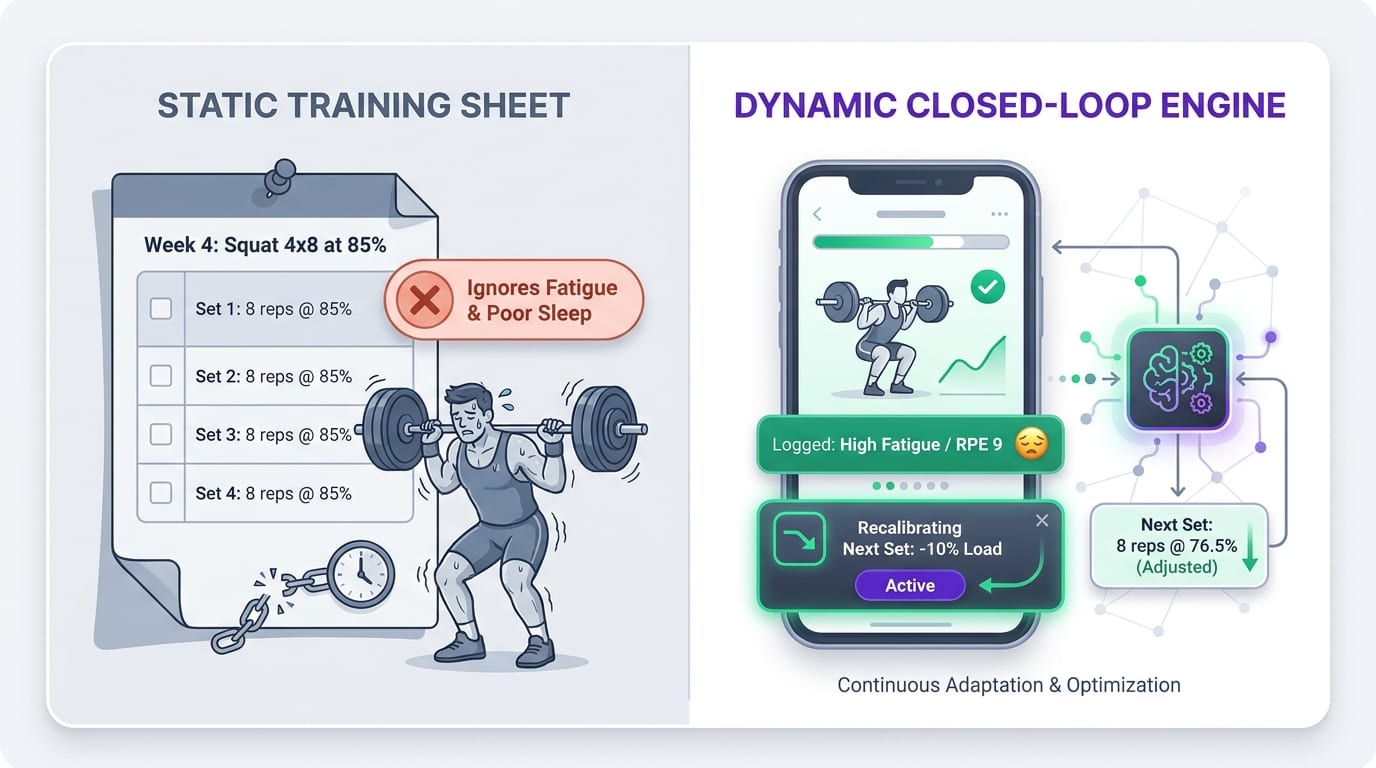
A static document establishes an immutable schedule created on the assumption of linear human recovery. It treats your physical performance as entirely predictable across an eight-to-sixteen-week macrocycle. It cannot detect poor sleep, systemic nervous system fatigue, or localized muscle soreness.
An adaptive generator operates on closed-loop feedback systems outlined in modern exercise science literature by the National Strength and Conditioning Association. Every completed repetition, load selection, and recorded exertion rating recalibrates subsequent loading parameters.
- Data intake mechanism: PDFs rely entirely on the lifter's manual pencil entries or third-party spreadsheet formulas.
- Input sensitivity: Algorithms modify upcoming sets within milliseconds of recording a high fatigue score.
- Progression logic: Static files prescribe rigid percentage increases, while software calculates moving averages.
- Format rigidity: Digital templates update variables dynamically, whereas printed sheets remain permanently frozen.

Static PDF Programs: Predictable Structure with Fixed Limits
Static PDF routines represent traditional sports periodization in its purest consumer format. Coaches design them with a definite physiological destination in mind, usually culminating in a planned strength test or targeted hypertrophy peak.
You receive total operational clarity from day one. You can inspect week eight's secondary pressing accessories before completing your introductory week one squat session. However, this total predictability becomes a structural liability when real-world interruptions occur.
- Zero digital friction: No battery anxiety, app crashes, connectivity dead zones, or software updates.
- Holistic program vision: The trainee sees the entire training arc, deloads, and testing weeks at a glance.
- One-time fee structure: You buy the instructional guide once and retain permanent ownership.
- Coaching narrative: High-quality PDFs include detailed movement rationale and biomechanical tips written directly by elite coaches.
The fundamental flaw of the static guide is complete systemic inflexibility. When life disrupts your training cadence, the document provides zero contextual guidance for recovery or re-entry.
- No built-in autoregulation: Forcing planned heavy triples during acute illness or fatigue spikes elevates injury risks.
- Manual math requirements: You must repeatedly calculate percentages against changing one-rep maximums manually.
- Exercise substitution blind spots: Replacing movements due to joint discomfort requires outside biomechanical knowledge.
- High abandonment rates: Missing three consecutive sessions often causes trainees to scrap the plan entirely.
AI Workout Generators: Autoregulation and Real-Time Adjustment
Modern fitness algorithms use dynamic load adjustment to modify working volume on the fly. Rather than adhering to fixed percentages, they employ the Rating of Perceived Exertion (RPE) system to match daily biological capability.
Peer-reviewed research indexed on PubMed demonstrates that autoregulated resistance training frequently produces superior strength gains compared to fixed loading schemes. When you perform better than average, the generator accelerates your progression.
- Dynamic load management: Software scales weight jumps up or down based on your warm-up bar velocity and reported RPE.
- Intelligent equipment substitution: Instantly converts a barbell movement to dumbbell or cable equivalents when stations are taken.
- Time-constrained session trimming: Compresses working sets systematically if your available training window suddenly drops to 30 minutes.
- Integrated exercise logging: Automatically tracks historical volume loads, estimated one-rep maximums, and personal milestones.

Despite technical superiority in data management, generative training interfaces introduce distinct friction points. Looking at a mobile display between exhausting compound sets can erode your psychological momentum.
- Ongoing subscription overhead: Software access stops the moment you terminate recurring monthly or annual billing.
- Screen habituation during rests: Constant phone handling invites notification distractions, extending rest intervals unintentionally.
- Black-box training paths: Trainees often cannot foresee what movements or rep ranges will appear next week.
- Algorithmic hallucination risks: Poorly tuned algorithms may combine conflicting movement patterns or overwork synergistic muscle groups.
Handling Missed Sessions, Equipment Bottlenecks, and Plateaus
Progressive overload relies on managing stress, recovery, and adaptation over time, a principle emphasized by the American College of Sports Medicine. How your training program accommodates friction determines whether you sustain long-term consistency.
68%
Lifters facing equipment bottlenecks during peak commercial gym hours
24-48h
Neuromuscular recovery window needed following fatiguing compound sessions
12-16 wk
Standard mesocycle block before periodized programs mandate deloading
When a lifter following a static PDF misses a session, they face a classic dilemma. Do you skip the workout entirely, or push the entire schedule forward and compromise recovery days? Most trainees choose incorrectly, accumulating residual fatigue.
An adaptive generator simply consolidates volume. If you miss your designated pulling session, the algorithm merges key back movements into your subsequent full-body workout or trims isolation volume to preserve recovery capacity.
Training progression is non-linear because human biology is volatile. Rigid plans break under real-world stress; adaptive frameworks bend and absorb it.
Overcoming performance plateaus reveals another operational divide. Standard templates address stalling through predetermined deloads, as detailed across the Journal of Strength and Conditioning Research. Algorithmic platforms can alternate stimulus density or swap repetition targets on the fly.
When metabolic conditioning demands alternative formats, lifters often rely on an amrap workout generator to establish high-density training without corrupting their primary strength foundations.
Cost Analysis: One-Time Purchase vs Recurring Subscription
The commercial differences between these formats represent two completely distinct financial philosophies. Static routines follow a traditional publishing model, while adaptive apps mirror enterprise SaaS structures.
Evaluating real value requires weighing long-term financial expenditure against your actual utilization rate. A single neglected month on an automated billing cycle erodes any theoretical software advantage.
| Feature / Attribute | Static PDF Program | AI Workout Generator |
|---|---|---|
| Billing Structure | Single one-off transaction | Monthly or annual subscription |
| Autoregulation Capabilities | Manual lifter discretion only | Automated set and load adjustment |
| Equipment Flexibility | Requires manual movement swaps | Instant single-tap substitutions |
| Offline Usability | 100% accessible via print or file | Requires intermittent data sync |
| Macrocycle Transparency | Complete visibility from day one | Dynamic, hidden upcoming sessions |
Lifters maintaining dedicated home gyms with fixed equipment often waste money on recurring apps. If your training gear never changes and your schedule remains static, paying a recurring monthly fee yields diminishing returns.
Decision Matrix: Which Format Fits Your Training Profile?
Selecting the correct format requires a candid evaluation of your lifestyle volatility, technical literacy, and training environment. Choosing the wrong methodology leads directly to programmatic friction and abandonment.
According to strength guidelines from the National Academy of Sports Medicine, exercise adherence correlates directly with how seamlessly a training regimen integrates into a person's daily life.
- Predictable daily schedule: You train at identical times consistently each week.
- Access to standardized gear: You have a reliable squat rack, bench, and barbell plates.
- Screen-free preference: You view your gym time as an intentional digital detox.
- Strict strength peaking: You are preparing for a sanctioned meet on a specific calendar date.
Conversely, an adaptive generator provides superior utility when training variables fluctuate beyond your direct control.
- Frequent travel: You frequently lift in hotel gyms with unpredictable dumbbell and cable setups.
- Peak-hour gym attendance: You constantly contend with occupied benches and crowded machines.
- Fluctuating recovery: Work shifts, childcare duties, or sleep interruptions cause volatile energy levels.
- Desire for automated tracking: You prefer algorithmic data analysis over manual notebook management.
Experienced trainees often deploy a hybrid strategy. They adopt the macrocycle structure of an established strength template and feed those parameters into an adaptive platform like Fitnix to manage automated exercise swaps and auto-regulated volume trimming.
Should you choose an AI workout generator or a static PDF workout program?
What are the main drawbacks of using a PDF workout plan?
How do AI workout generators adapt to missed workouts or busy gym equipment?
Is an AI workout app worth the recurring subscription over a one-time PDF purchase?
Sources & References
- National Strength and Conditioning Association — Foundational standards and research supporting resistance training periodization and exercise science principles.
- American College of Sports Medicine — Clinical guidelines regarding exercise prescription, progressive overload, and physical adaptation tolerances.
- National Academy of Sports Medicine — Training adherence models, exercise progression protocols, and baseline movement mechanics.
- PubMed Central: Autoregulation Study — Clinical investigation evaluating autoregulated versus fixed linear loading protocols in trained athletes.
- Wikipedia: Sports Periodization — Overview of athletic macrocycle, mesocycle, and microcycle structural programming.
- Wikipedia: Rating of Perceived Exertion — Definitions and application parameters for RPE scales in strength autoregulation.
- Journal of Strength and Conditioning Research — Peer-reviewed studies covering fatigue accumulation, deload intervals, and resistance training adaptations.