
Blog
Single Kettlebell Complex Workout Routine: Full Guide
Master the single kettlebell complex workout routine. Learn the weakest link rule, optimal sequencing, and three full turnkey training templates.
Single Kettlebell Complex Workout Routine: Full Guide
Build dense muscle, incinerate fat, and boost raw conditioning using only one weight and zero downtime.
You can build elite conditioning and full-body strength in under 30 minutes using nothing more than a single cast-iron bell. Executing a single kettlebell complex workout routine requires you to transition through compound lifts on one side without putting the weight down until the entire sequence is complete, as established by StrongFirst kettlebell protocols.
The Non-Negotiable Rules of a Kettlebell Complex
A kettlebell complex is a series of multi-joint exercises performed consecutively with the same weight without setting the bell down. While a standard circuit permits short pauses between movements, a complex demands continuous time under tension throughout the sequence.
Unlike a flow where you switch exercises every single repetition, a complex requires finishing all target repetitions of one movement before advancing to the next. The American Council on Exercise highlights that sustained unilateral loading magnifies core engagement and demands total kinetic chain stability.
- Zero ground contact: The kettlebell touches the floor only when all exercises on the designated side are finished.
- Block rep completion: Complete all 5 cleans before starting your 5 presses; never alternate movements rep-by-rep.
- Seamless transitions: Shift cleanly between positions—such as descending from the rack directly into a front squat.
- Unilateral completion: Finish the entire sequence on your weaker arm before resting or transferring the bell to your dominant side.
A complex turns a moderately light kettlebell into an unyielding test of core stability, grip resilience, and lung capacity.
Movement Sequencing: From Precision to Grunt Work
Exercise order within a complex must prioritize central nervous system freshness over sheer metabolic burnout. Explosive, high-skill movements belong at the start of the round when your neuromuscular coordination is sharpest.
According to sequencing research published by the National Strength and Conditioning Association, technical breakdown spikes dramatically when ballistic lifts follow fatiguing grinds. Placing a snatch after high-rep squats invites wrist, elbow, and shoulder trauma.
- High-skill ballistics (Snatch or Clean): Requires maximum speed, pristine trajectory, and sharp grip timing.
- Overhead grinds (Strict Press or Push Press): Demands stable rotator cuffs and rigid glute activation under early fatigue.
- Squat variations (Front Squat or Lunge): Transfers the primary metabolic stress to large quadriceps and hip musculature.
- Finishing hinges (One-Arm Swing): Relies on raw posterior chain propulsion when your upper body can no longer press safely.
4-5
Optimal movements per complex
5-6 reps
Ideal volume per movement
90-120s
Typical time under tension per round
Load Selection and the Weakest Link Principle
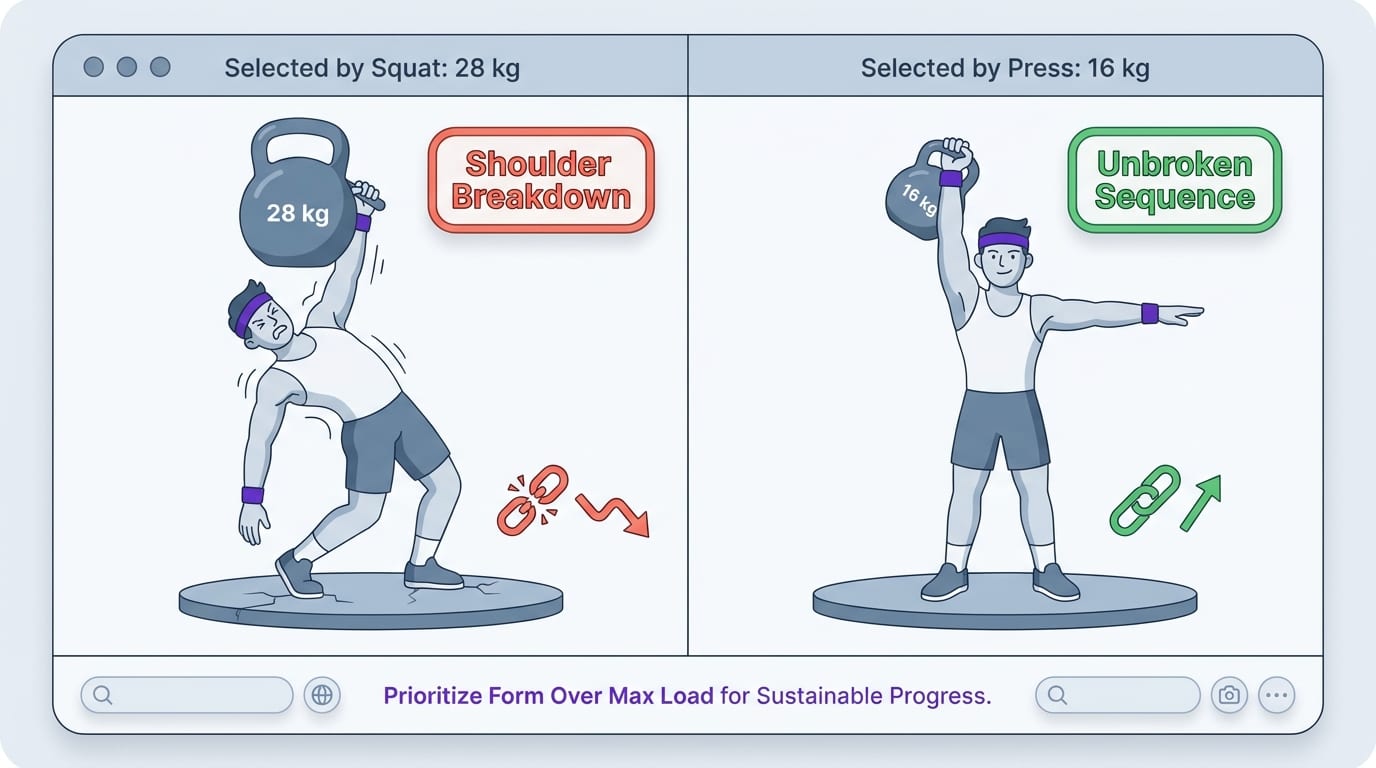
Your working weight is dictated strictly by the exercise in your sequence that you perform with the least strength. Because you cannot change bells mid-round, your overhead press strength governs the load for your squats and swings.
If you can squat a 28 kg bell but can only strict press a 16 kg bell for 5 clean reps, you must use the 16 kg bell. Biomechanical guidelines on ExRx.net note that exceeding joint capacity during compound pressing compromises spinal stability.
| Exercise | Technical Demand | Relative Strength Capacity | Limiting Mechanism |
|---|---|---|---|
| Overhead Press | Moderate | Lowest (Baseline) | Shoulder deltoid and triceps stamina |
| Kettlebell Snatch | Very High | Moderate | Grip endurance and timing |
| Front Rack Squat | Low-Moderate | High | Thoracic spine extension under load |
| One-Arm Swing | Moderate | Highest | Forearm flexors and hip power output |
For men with baseline strength, a 16 kg bell is the standard testing ground, while seasoned lifters thrive with a 20 kg or 24 kg bell. Women should typically start with an 8 kg or 12 kg bell before progressing to a 16 kg load.
Three Turnkey Single Kettlebell Complex Routines
Select one of the following turnkey complexes based on your primary training goal. If you are balancing this with broader strength goals, review our guide on kettlebells full body workout structures to integrate complexes seamlessly.
Perform all prescribed reps on your non-dominant arm, park the bell, rest for 60 seconds, and repeat on the opposite arm. Complete 3 to 5 total cycles across your session.
- Routine 1: The Armor Builder (Hypertrophy & Strength)
- • 5 Kettlebell Cleans (clean from the floor each rep)
- • 5 Overhead Strict Presses (pause 1s at lockout)
- • 5 Racked Front Squats (drive elbows forward)
- • 5 Bent-Over Single-Arm Rows (flat back, neutral neck)
- • Protocol: Run 4 rounds per arm, resting 90 seconds between arm switches.
Metabolic studies cited in PubMed Central research confirm that continuous unilateral complexes produce dramatic cardiovascular and caloric expenditure comparable to high-intensity sprint intervals.
- Routine 2: The Conditioning Engine (Fat Loss & Work Capacity)
- • 5 One-Arm Kettlebell Snatches (tame the arc overhead)
- • 5 Push Presses (slight dip and violent knee extension)
- • 5 Racked Reverse Lunges (step back on the same-side leg)
- • 10 One-Arm Swings (snap hips hard, hinge deep)
- • Protocol: Complete 3 to 4 rounds per arm; take 120 seconds rest after both arms work.
The Minimalist Engine delivers maximum impact when training time is severely restricted. It strips away high-skill snatches in favor of raw brute force and steady pacing.
- Routine 3: The Minimalist Engine (Strength-Endurance)
- • 6 Kettlebell Cleans
- • 6 Racked Front Squats
- • 6 Push Presses
- • Protocol: 5 rounds per side. Switch sides immediately with zero rest, then take 2 minutes after both sides finish.
Rest Intervals, Grip Longevity, and Weekly Programming
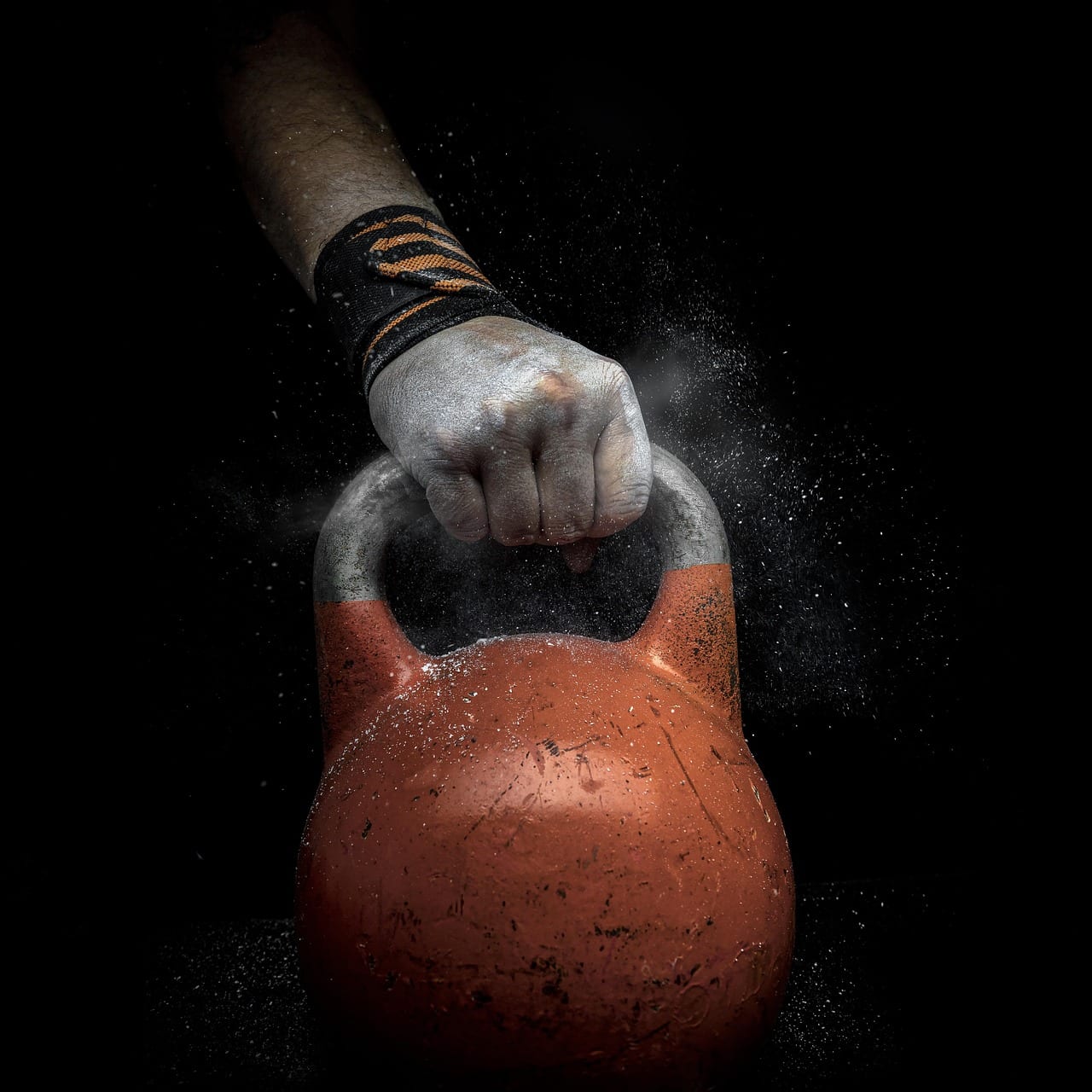
Grip failure is the single greatest threat to safety and output during complexes. When your digital flexors fatigue, your shoulder elevates, thoracic alignment collapses, and the bell pulls you out of your natural movement grooves.
Utilize a loose finger hook rather than a death-grip squeeze during the downswing of swings and cleans, as detailed in BarBend's kettlebell mechanics guide. Relax your forearms during the lockout phase of overhead presses to preserve forearm stamina.
- Manage work-to-rest ratios: Adhere to the American College of Sports Medicine interval guidelines of a 1:2 or 1:3 ratio to clear lactic acid.
- Frequency guidelines: Program complexes 2 to 3 days per week on non-consecutive days such as Monday, Wednesday, and Friday.
- Active recovery: Pair training days with our recommended AI mobility routine to relieve thoracic and hip flexor tension.
- Systemic fatigue management: If your resting heart rate elevates or grip strength declines, consult Mayo Clinic recovery principles and reduce round volume.
If you are new to high-density training blocks, consult our foundational tutorial on how to start fitness routine habits before jumping directly into advanced 5-round complexes.
For lifters who want personalized volume autoregulation and progression feedback without manual tracking, Fitnix dynamically scales your complex density based on real-time fatigue and recovery metrics.
What is the key difference between a complex, a circuit, and a flow?
How do I choose the correct weight if my squat is much stronger than my press?
Can I do a single kettlebell complex routine every day?
What should I do if my grip gives out mid-round?
Sources & References
- StrongFirst — Standardized kettlebell safety, unilateral movement integrity, and hardstyle complex protocols
- American Council on Exercise — Research on functional training benefits and core activation under unilateral loads
- National Strength and Conditioning Association — Exercise order principles and neuromuscular fatigue mitigation strategies
- ExRx.net — Biomechanical profiles and joint capacity data for overhead pressing and hip hinge lifts
- PubMed Central — Peer-reviewed physiological analysis of caloric output and heart rate responses during kettlebell routines
- BarBend — Technical breakdown of kettlebell hook grip techniques and forearm tension conservation
- American College of Sports Medicine — Evidence-based guidelines for interval rest ratios and metabolic conditioning recovery
- Mayo Clinic — Physiological symptoms of overtraining, connective tissue stress, and nervous system recuperation