
Blog
German Volume Training (GVT): The Complete 10x10 Guide
Master German Volume Training with this complete 10x10 protocol guide. Learn exact starting loads, rest intervals, 5-day splits, and progression rules.

German Volume Training (GVT): The Complete 10x10 Guide
Break hypertrophy plateaus with the definitive high-volume protocol for packing on lean muscle mass.
If you want to pack on dense muscle mass in six weeks, german volume training delivers unmatched hypertrophic stimulus through extreme cumulative fatigue. You need access to standard free weights, an accurate record of your one-rep maximums, and roughly 60 minutes per session. Clinical research published in the Journal of Strength and Conditioning Research confirms that high-set volume schemes produce rapid muscular adaptations when lifters follow structured rest and loading parameters.
Core Mechanics: How the 10x10 Protocol Drives Hypertrophy
German Volume Training relies on performing 10 sets of 10 repetitions with a fixed load for one primary compound movement per muscle group. Rather than varying the resistance across sets, you expose a single motor unit pool to relentless, repeated contractions under strict intervals.
| Training Variable | Primary Tier (10x10) | Secondary Tier (Accessory) | Physiological Goal |
|---|---|---|---|
| Set & Rep Scheme | 10 sets of 10 reps | 3 sets of 10–12 reps | Maximal motor unit fatigue |
| Intensity (% 1RM) | 60% of 1RM (20RM load) | 65%–70% of 1RM | High volume without early failure |
| Rest Interval | 60–90 seconds | 60 seconds | Metabolic metabolite pooling |
| Cadence (Tempo) | 4-0-2-0 (eccentric focus) | 3-0-1-0 (controlled) | Extensive time under tension |
The mechanism driving growth here is not maximal mechanical tension from ultra-heavy singles, but extensive metabolic stress and motor unit exhaustion. Systematic reviews in Sports Medicine emphasize that high training volume serves as a primary driver of muscle hypertrophy when sets approach technical failure.
Because you repeat the exact same movement pattern for 100 reps, your nervous system progressively recruits high-threshold motor units as lower-threshold fibers fatigue, adhering to Henneman's size principle. You can read more about balancing workout volume and intensity to fine-tune stimulus.
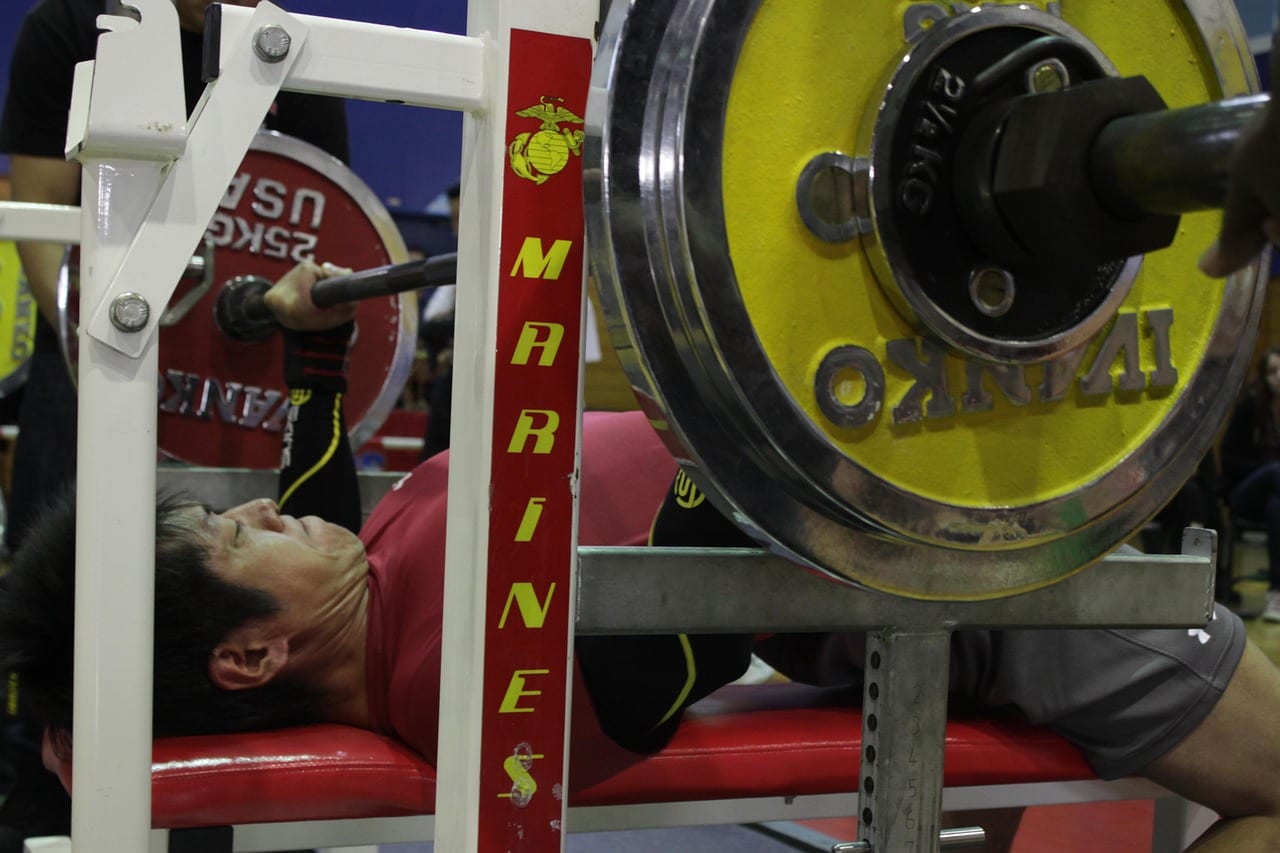
- Single primary movement: Select exactly one multi-joint compound lift per muscle grouping for the 10x10 block.
- Fixed resistance: Do not alter the barbell load between sets 1 and 10 regardless of fatigue.
- Antagonistic pairing: Pair opposing movement patterns (such as a bench press and a barbell row) into alternating sequences.
- Volume discipline: Restrict direct arm, shoulder, and core accessory work to three lighter sets.
Calculating Load: Starting Weight and Load Selection
Your starting weight for any 10x10 exercise must be exactly 60% of your one-rep maximum (1RM) or a weight you can handle for 20 continuous repetitions. Lifters who estimate their load based on a typical 10-rep max will fail completely before finishing set six.
If your tested 1RM on the back squat is 315 pounds (143 kg), your working weight is 190 pounds (86 kg). You can verify your exact percentage calculations using standard conversion models from ExRx.net. Precision matters because a 5-pound discrepancy compounds across 100 cumulative repetitions.
60%
Prescribed 1RM starting weight
100
Target reps per primary lift
4–5%
Load increase upon success
4–6 Wks
Optimal program duration
The psychological trajectory of a 10x10 workout follows a predictable pattern. Sets one through three will feel deceptively light, leading many athletes to erroneously increase the weight. Avoid this urge. Cumulative fatigue peaks abruptly during sets seven, eight, and nine as metabolic waste products saturate working tissue.
- Determine your verified 1RM: Use a tested single or calculate it from a verified 3-rep to 5-rep maximum.
- Multiply by 0.60: Calculate the exact 60% figure and round down to the nearest practical plate increment.
- Resist early weight increases: Keep the load constant through the easy early sets to preserve neural capacity.
- Log every completed rep: Record individual rep completions across all 10 sets (e.g., 10, 10, 10, 10, 9, 8, 8, 7, 7, 7).
Lifting Tempo, Rest Intervals, and Exercise Selection
Execute every primary 10x10 compound lift using a strict 4-0-2-0 tempo paired with timed 60 to 90-second rest intervals. Without tempo regulation, lifters instinctively speed up repetitions to utilize elastic recoil, undermining the high time-under-tension requirements of the protocol.
Under a 4-0-2-0 tempo, you spend four seconds on the eccentric (lowering) phase, take zero seconds pause at the stretch, take two seconds to lift the weight concentrically, and pause zero seconds at lockout. That equates to six seconds per repetition, or 60 full seconds of tension per 10-rep set.
Controlling the eccentric phase under strict rest intervals forces high-threshold motor unit recruitment without relying on ultra-heavy mechanical loads.
Keep rest intervals strictly timed on a stopwatch. Guidelines from the American College of Sports Medicine and resistance training analyses indexed on PubMed confirm that restricted rest intervals between 60 and 90 seconds maximize metabolic accumulation, growth hormone secretion, and localized muscle fatigue.

- Tier 1 selection criteria: Choose compound lifts with high bilateral stability (e.g., barbell back squats, flat bench presses, chin-ups, bent-over rows).
- Lifts to avoid for 10x10: Never run 10x10 on technical Olympic lifts, standard deadlifts, or lower back extensions due to spinal erector fatigue.
- Tier 2 accessory criteria: Select isolated or machine movements (e.g., incline dumbbell curls, triceps pushdowns, lateral raises) performed for 3 sets of 10–12 reps.
- Accessory tempo: Execute accessory exercises with a faster 3-0-1-0 tempo and 60 seconds of recovery.
The 5-Day German Volume Training Workout Routine
The most effective structure for German Volume Training is a 5-day split cycle that pairs opposing muscle groups using antagonistic supersets. The antagonist structure, popularized on Poliquin Group archives and competitive coaching resources at BarBend, allows one muscle group to recover while its counterpart works.
In an antagonistic superset (labeled A1 and A2), perform 10 reps of A1, rest 90 seconds, perform 10 reps of A2, and rest 90 seconds. Repeat this alternation until you complete all 10 sets of both exercises. This schedule contrasts with high-intensity low-volume frameworks like reverse pyramid training.
- Day 1 (Chest & Back): A1. Barbell Flat Bench Press (10x10, 4-0-2-0 tempo, 90s rest); A2. Barbell Bent-Over Row (10x10, 4-0-2-0 tempo, 90s rest); B1. Incline Dumbbell Flye (3x10–12, 3-0-1-0 tempo, 60s rest); B2. Close-Grip Lat Pulldown (3x10–12, 3-0-1-0 tempo, 60s rest).
- Day 2 (Legs & Abs): A1. Barbell Back Squat (10x10, 4-0-2-0 tempo, 90s rest); A2. Lying Hamstring Leg Curl (10x10, 4-0-2-0 tempo, 90s rest); B1. Standing Calf Raise (3x10–12, 3-0-1-0 tempo, 60s rest); B2. Hanging Leg Raise (3x10–12, 2-0-2-0 tempo, 60s rest).
- Day 3 (Rest): Full active recovery, mobility drills, light walking, and targeted nutritional replenishment.
- Day 4 (Arms & Shoulders): A1. Parallel Bar Triceps Dips (10x10, 4-0-2-0 tempo, 90s rest); A2. Incline Dumbbell Hammer Curl (10x10, 4-0-2-0 tempo, 90s rest); B1. Dumbbell Lateral Raise (3x10–12, 3-0-1-0 tempo, 60s rest); B2. Dumbbell Rear Delt Flye (3x10–12, 3-0-1-0 tempo, 60s rest).
- Day 5 (Rest): Complete rest before restarting the cycle on Day 6. This creates a rotating 5-day cycle across the calendar.

Progression Rules, Managing Failure, and Mesocycle Duration
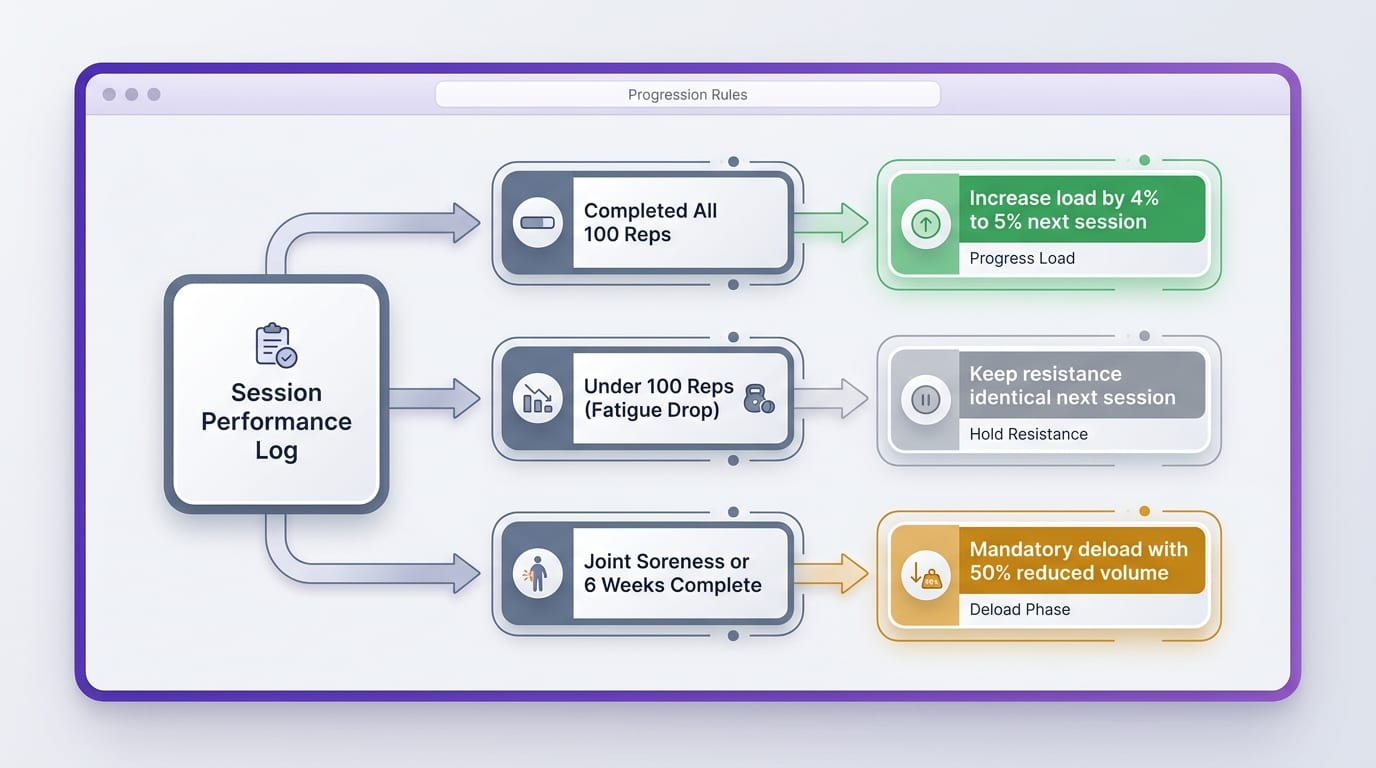
Increase your working weight by 4% to 5% in the following workout only when you achieve a complete 10x10 score of 100 reps. If your rep count drops on later sets, keep the resistance unchanged for your next session.
A typical progression path features rep drops in the middle of the block. You might hit 10 reps on sets one through four, drop to 8 or 7 on sets five through eight, and rally to hit 8 reps on sets nine and ten. Do not reduce the load when reps drop. Maintain the weight and aim to complete more total reps next session.
Limit your German Volume Training mesocycle to a strict maximum of four to six consecutive weeks. Research from Frontiers in Physiology and foundational strength principles detailed by Human Kinetics illustrate that extreme volume training triggers severe neuromuscular fatigue if maintained past six weeks.
After finishing a 6-week GVT cycle, transition into a functional hypertrophy block focusing on heavier loads (6 to 8 reps) and lower total volume (3 to 4 working sets). If you need help managing these periodized transitions, utilizing AI for strength training ensures your volume matches your personal recovery markers.
- Persistent joint soreness: Persistent discomfort in your elbows, knees, or lower back indicates joint irritation from excessive volume.
- Performance collapse: Failing to match your previous session's total reps signifies accumulated central nervous system burnout.
- Sleep disturbances: Waking up frequently or experiencing elevated resting heart rates signals overreaching.
- Mandatory deload week: Take a low-volume deload week with 50% reduced volume before beginning your next training block.
What is German Volume Training and how do you do it?
What percentage of 1RM should you use for GVT?
How long should you rest between 10x10 sets?
When do you increase the weight on German Volume Training?
How many weeks should you run German Volume Training?
Sources & References
- Journal of Strength and Conditioning Research — Amirthalingam et al. study investigating modified 10-set vs 5-set volume hypertrophy outcomes.
- Sports Medicine — Peer-reviewed analyses on resistance training volume dose-response relationships for muscular hypertrophy.
- ExRx.net — Exercise science resource detailing one-rep maximum percentage conversions and repetition predictions.
- American College of Sports Medicine — Professional guidelines outlining resistance training rest intervals, loading parameters, and volume management.
- PubMed Central — Clinical studies reviewing metabolic stress, eccentric time under tension, and hypertrophic adaptations.
- Poliquin Group — Foundational coaching archives documenting the antagonist superset structure and 4-0-2-0 lifting tempos.
- BarBend — Practical strength training analysis detailing exercise selection and weekly split scheduling.
- Frontiers in Physiology — Research examining central nervous system fatigue and neuromuscular recovery following extreme volume protocols.
- Human Kinetics — Academic textbook and physiological foundations for periodized strength and conditioning models.