
Blog
Drop Sets vs. Supersets: Differences and When to Use Each
Learn the physiological differences between drop sets and supersets, compare recovery demands, and discover which technique fits your lifting goals.

Drop Sets vs. Supersets: Differences and When to Use Each
Cut training time or exhaust muscle fibers: how to choose the right advanced lifting technique.
If you need maximum metabolic fatigue in a single muscle group, pick drop sets; if you want to complete your workout in half the time without sacrificing volume, choose supersets. Deciding between drop sets vs supersets depends on whether your primary restriction is localized muscular exhaustion or overall session density.
Mechanics and Physiology of Drop Sets
A drop set extends a resistance training set beyond momentary muscular failure by immediately reducing the external load and continuing repetitions. Rather than racking the weight when form breaks down, you lighten the resistance to keep muscle fibers working under load.
Standard sets stop when you reach concentric failure because your motor units can no longer generate enough force to move that specific weight. Peer-reviewed research cataloged on PubMed demonstrates that dropping the load immediately recruits lower-threshold motor units while maintaining tension on fatigued high-threshold fibers.
The underlying physiological driver of a drop set is metabolic stress. Rapid accumulations of hydrogen ions, inorganic phosphate, and lactate pool inside the muscle tissue, inducing cell swelling. According to the National Strength and Conditioning Association, this localized hypoxia triggers anabolic signaling pathways essential for muscular growth.
- Perform the primary set to momentary failure: Complete 8 to 12 controlled reps using an assigned working weight until you cannot finish another concentric rep.
- Reduce the load by 20% to 25%: Strip plates or move the selectorized pin upward within five seconds to prevent neuromuscular recovery.
- Resume reps immediately: Continue repetitions to technical failure with zero scheduled rest between the weight change and your next rep.
- Perform one to two drops maximum: Limit the sequence to two weight reductions per exercise to avoid excessive central nervous system drain.
Mechanics and Variations of Supersets
A superset links two separate exercises performed back-to-back with little to no rest between them. While drop sets push one movement past failure, supersets alternate between movement patterns to increase training density and elevate work capacity across your workout.
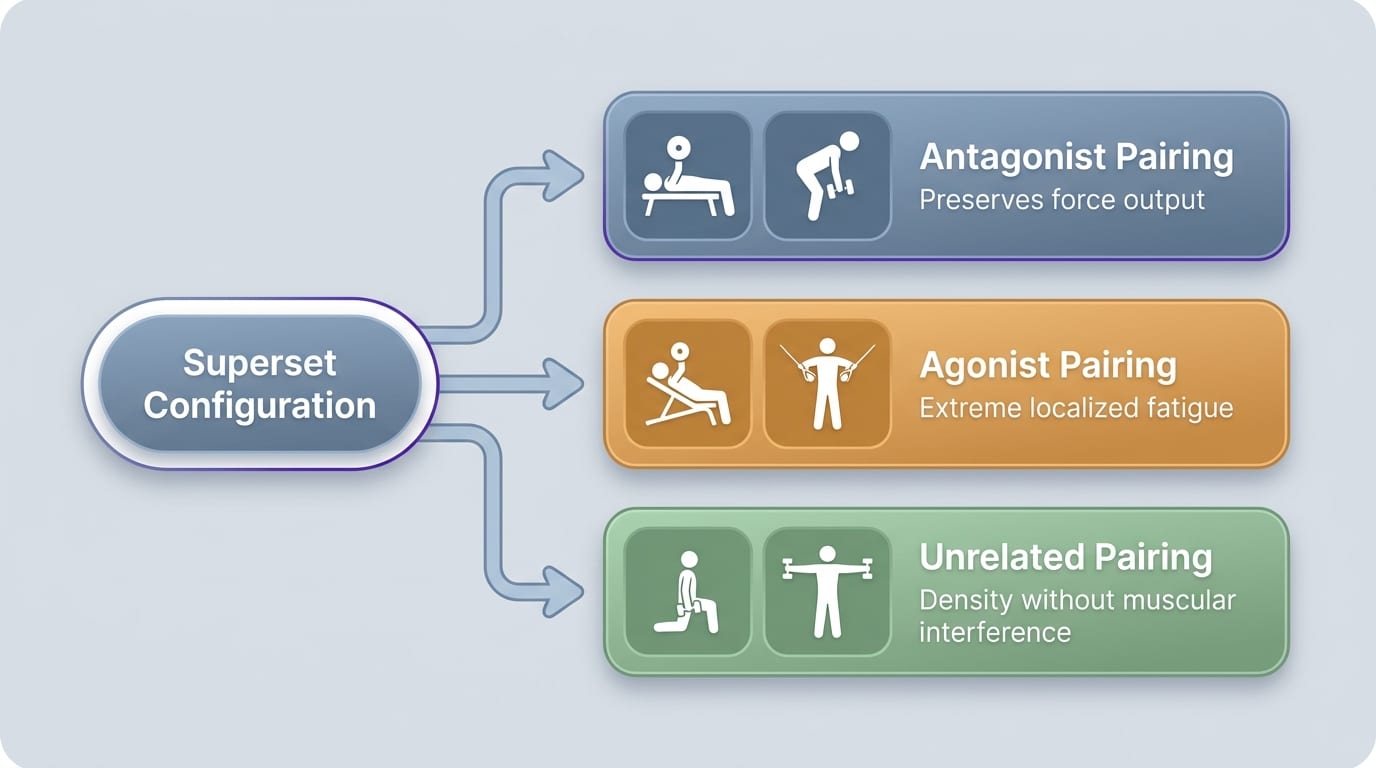
The physiological impact of a superset changes based on the muscle groups you pair together. As outlined on Wikipedia's training index, lifters categorize supersets into three common configurations, each serving distinct metabolic and neuromuscular objectives.
- Antagonist supersets: Pairing opposing muscle groups, such as a barbell bench press followed immediately by a barbell bent-over row. While the agonist contracts, the antagonist recovers, preserving prime-mover force output.
- Agonist supersets (compound sets): Pairing two movements targeting the identical muscle group, such as an incline dumbbell bench press followed by a cable fly. This creates intense localized fatigue similar to an extended set.
- Unrelated supersets: Alternating completely distinct body parts, such as Bulgarian split squats followed by lateral raises. This maximizes workout efficiency without causing peripheral muscular interference.
Guidelines from the American College of Sports Medicine emphasize that antagonist pairings cause minimal performance decrement. Working your triceps between sets of biceps curls allows the elbow flexors to rest passively while reciprocal inhibition may even enhance subsequent contraction power.
Drop Sets vs. Supersets: Direct Head-to-Head Comparison
Choosing between these protocols requires balancing local metabolic exhaustion against overall workout pace. While both compress training time compared to traditional straight sets, they stress your energy systems in fundamentally different ways.
| Variable | Drop Sets | Supersets (Antagonist) |
|---|---|---|
| Primary Stimulus | Metabolic stress & localized motor unit exhaustion | Mechanical tension & aerobic work density |
| Rest Between Bouts | 0 to 5 seconds during weight drops | 0 to 30 seconds between exercises; 90s after pair |
| Volume Accumulation | High repetitions at declining load on one movement | Equal volume across two movements in parallel |
| Systemic Cardiovascular Demand | Moderate; temporary acute spike in heart rate | High; sustained elevated heart rate throughout |
| Best Exercise Type | Isolation exercises and selectorized machines | Compound and isolation movements combined |
| Session Time Savings | Moderate; saves time on the final exercise | Exceptional; cuts overall workout time by 30-50% |
A critical trade-off centers on mechanical tension. Research published in Springer Sports Medicine indicates that high mechanical tension under heavy loads drives foundational hypertrophy. Because drop sets require reducing the load, absolute force production drops quickly across each mini-set.
Conversely, antagonist supersets preserve load intensity. If you pair a heavy overhead press with a weighted pull-up, each muscle group receives 2 to 3 minutes of effective rest before its next working set, keeping velocity and load high.
- Drop sets excel at metabolic accumulation: They trap blood in the working tissue, promoting intracellular hydration and localized hormone signaling.
- Supersets optimize workout density: They double the work completed per unit of gym time without forcing you to strip weight from the bar.
- Energy pathway differences: Drop sets drain localized anaerobic phosphagen stores, whereas supersets challenge oxidative recovery between opposing sets.
Choosing the Right Method for Your Training Goal
Your primary athletic outcome dictates whether to load your schedule with drop sets or supersets. Applying the wrong intensity technique at the wrong phase of your training block sabotages strength progression and limits long-term gains.
For pure muscle growth, both approaches produce comparable outcomes when volume is matched. If you want a deeper breakdown of load parameters and volume benchmarks, review our guide on understanding sets and reps before programming your split.
When strength is the priority, supersets win over drop sets, provided they are antagonist or unrelated pairings. High-load neurological adaptations require crisp force output. Training to complete muscular collapse on drop sets harms bar speed and diminishes motor control on heavy lifts.
- Choose drop sets for stubborn hypertrophy: Use them on lagging muscle groups that struggle to reach complete exhaustion with standard straight sets.
- Choose supersets for schedule compression: If you have only 40 minutes to train, antagonist supersets maintain total volume without cutting sets.
- Avoid drop sets for absolute strength: Stripping weight teaches muscles to fire under fatigue but reduces the peak neuromuscular recruitment needed to move maximal 1RM loads.
- Deploy agonist supersets sparingly: Limit same-muscle supersets to advanced hypertrophy specialization phases due to extreme peripheral muscle breakdown.
Managing Fatigue and Systemic Recovery Demands
Pushing past concentric failure with drop sets generates high localized muscle damage and peripheral nervous fatigue. The sudden accumulation of metabolic waste products impairs calcium ion release inside the sarcoplasmic reticulum, blunting force production for up to 72 hours.
Supersets redistribute strain across opposing muscular systems, reducing localized micro-tears but elevating systemic fatigue. Clinical studies indexed in the Journal of Strength and Conditioning Research reveal that paired compound movements produce significantly higher cardiorespiratory stress than standard straight sets.
The limiting factor in an advanced lifting session should always be the target muscle tissue, not systemic cardiovascular failure or premature neurological burnout.
If you perform excessive drop set volume across multiple exercises in one workout, recovery demands outpace muscle protein synthesis. Chronic exposure to multiple drops per session frequently triggers tendon irritation, joint inflammation, and elevated resting heart rate.
- Lingering muscular soreness beyond 72 hours: Suggests your drop sets caused excessive structural damage to muscle fibers.
- Declining force output across sessions: Inability to match previous weights indicates central nervous system exhaustion from repeated failure training.
- Intra-set breathlessness during supersets: Signal that cardiovascular conditioning, rather than target muscle strength, is limiting set completion.
- Degraded lifting mechanics on final drops: Breakdown in joint alignment means local stabilizers have failed, raising injury risk.
Exercise Selection Guidelines for Each Technique
Safety and biomechanics dictate which exercises you should use for each intensity technique. Free-weight compound exercises like squats, deadlifts, and overhead presses carry an inherent risk of spinal flexion or loss of balance when taken past complete technical failure.
Analysis from Stronger by Science stresses that systemic stabilizer fatigue becomes hazardous during multi-joint axial lifts. Consequently, drop sets belong almost exclusively on isolation exercises, cables, and pin-loaded machines where a fixed path of motion prevents disastrous missed reps.
- Cable lateral raises and triceps pressdowns: Allow immediate pin adjustments with continuous muscular tension across the entire active range of motion.
- Leg extensions and seated leg curls: Secure the lumbar spine while allowing quadriceps and hamstrings to reach pure motor unit failure safely.
- Dumbbell bicep curls ('running the rack'): Enable lifters to move down the dumbbell rack in 5-pound increments without requiring a spotter.
For supersets, pairing non-competing muscle groups prevents structural fatigue from overlapping. You can pair a heavy free-weight movement with an opposing compound or isolation movement without degrading joint positioning or stability.
- Dumbbell flat bench press + Chest-supported dumbbell row: Balances horizontal push and horizontal pull forces without compressing the spine.
- Standing overhead barbell press + Lat pulldown: Pairs vertical pushing with vertical pulling, maintaining shoulder girdle balance and scapular health.
- Barbell Romanian deadlift + Standing calf raise: Combines a posterior chain compound movement with an isolation exercise that requires negligible systemic energy.
Programming Rules and Combining Both in One Routine
You can combine drop sets and supersets inside the same workout session if you establish strict hierarchy and limit weekly volume. Structuring your workout from highest neural demand to lowest ensures technical safety on heavy lifts.
Begin your session with traditional heavy compound lifts, transition into antagonist supersets during the accessory phase, and finish with a single drop set on an isolation movement. Peer-reviewed protocols in Frontiers in Physiology support placing high-fatigue techniques at the very end of workouts.
- Anchor the first movement with straight sets: Perform 3 to 4 heavy sets of your primary compound movement with 2 to 3 minutes of dedicated rest.
- Program antagonist supersets in the mid-workout window: Pair secondary accessories (like dumbbell rows and incline presses) for 3 rounds to condense time.
- Deploy a single drop set as a finisher: Execute one multi-drop sequence on the final isolation exercise of the day to deplete remaining glycogen stores.
- Cap weekly intensity exposure: Limit total drop sets to 2 to 4 sets per muscle group each week to prevent systemic overreaching.
If you want precise volume tracking without guesswork, Fitnix automatically factors intensity techniques, fatigue management, and equipment access into an adaptive training plan built for your exact schedule.
Which builds more muscle: drop sets or supersets?
Can you use drop sets and supersets in the same workout?
How many drop sets should you do per workout?
Are drop sets safe for heavy compound lifts like squats and bench presses?
Sources & References
- PubMed — Systematic review evaluating the effects of drop sets and advanced resistance training techniques on muscular hypertrophy.
- National Strength and Conditioning Association — Foundational resistance training guidelines and physiological adaptations to metabolic stress.
- Wikipedia — Structural definitions, agonist-antagonist pairings, and history of superset methodologies.
- American College of Sports Medicine — Official position stand on exercise volume, density, and progressive overload recommendations.
- Springer Sports Medicine — Research exploring mechanical tension versus metabolic stress pathways in skeletal muscle growth.
- Journal of Strength and Conditioning Research — Empirical studies measuring cardiovascular demand and volume accumulation across antagonist supersets.
- Stronger by Science — Biomechanical assessments of fatigue management, motor unit recruitment, and exercise selection.
- Frontiers in Physiology — Exercise sequencing analysis and recovery curves following failure-focused resistance training.