
Blog
Conjugate Training System: Principles and Programming
Master the conjugate training system. Learn the 4-day split, max and dynamic effort methods, and how to program variations to break strength plateaus.

Conjugate Training System: Principles and Programming
A practitioner's blueprint for balancing max effort, dynamic velocity, and high-volume accessory work without plateauing.
If your progress on linear cycles has stalled, mastering the conjugate training system gives you a dependable path to build maximal strength and explosive speed simultaneously. Programming this concurrent model requires four weekly sessions of 60 to 75 minutes, barbell equipment with bands or chains, and an established technical baseline.
Unlike traditional periodization models that isolate one physical quality for months at a time, concurrent programming develops multiple adaptations within the same week. Research published by the National Strength and Conditioning Association confirms that concurrent strength and velocity work prevents neuromuscular stagnation while preserving peak force output.
| Training Day | Primary Method | Target Intensity | Core Objective |
|---|---|---|---|
| Day 1: ME Lower | Max Effort | 90%–100% 1RM | Work up to a heavy 1–3 rep max on a squat or deadlift variation |
| Day 2: ME Upper | Max Effort | 90%–100% 1RM | Work up to a heavy 1–3 rep max on a press variation |
| Day 3: DE Lower | Dynamic Effort | 50%–60% + 25% bands/chains | 10–12 sets of 2 reps on box squat with maximal bar speed |
| Day 4: DE Upper | Dynamic Effort | 50%–60% + 25% bands/chains | 9 sets of 3 reps on bench press using three distinct hand grips |
The Three Pillars of Conjugate Periodization
The conjugate methodology functions on a simple physiological rule: you cannot develop complete strength without simultaneously improving maximum force production, explosive speed, and structural hypertrophy.
In classical linear periodization, lifters spend weeks on hypertrophy, then shift to strength, and finally speed. By the time you reach peak strength, your conditioning and explosive speed have decayed. Renowned sports scientist Vladimir Zatsiorsky demonstrated that physical qualities deteriorate when left unaddressed for more than two to three weeks.
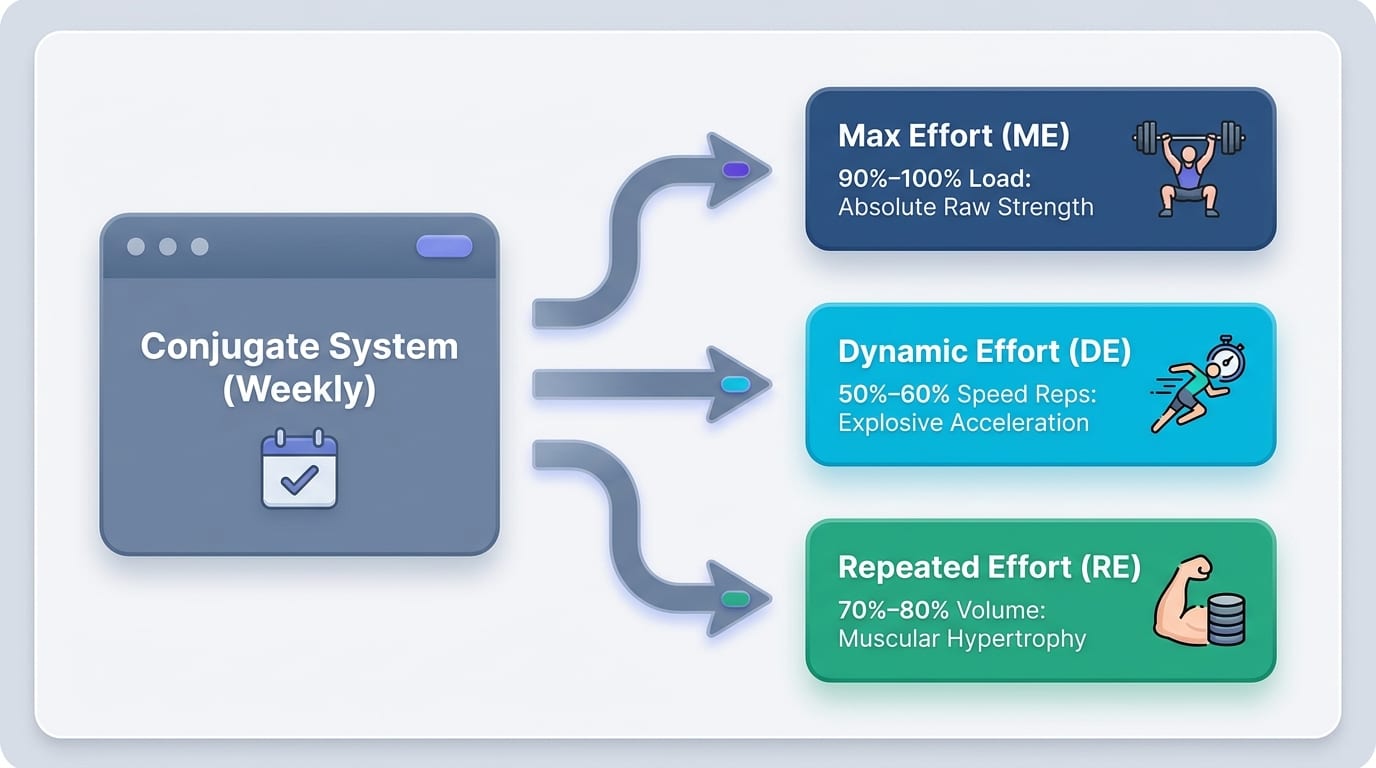
Conjugate solves this decay through the Law of Accommodation, which states that biological systems adapt to constant stimuli over time, causing diminishing returns. Instead of grinding through identical compound lifts until your joints ache, you cycle three distinct methods weekly:
- Max Effort Method (ME): Straining against 90% to 100% loads to recruit the highest-threshold motor units and build absolute raw strength.
- Dynamic Effort Method (DE): Moving submaximal loads (50% to 60%) at maximum velocity to enhance your Rate of Force Development (RFD).
- Repeated Effort Method (RE): Lifting non-maximal loads to near muscular failure to stimulate hypertrophy and strengthen connective tissues.
According to biomechanical analyses archived on ScienceDirect, recruiting high-threshold motor units under Henneman's size principle requires either maximal load or maximum acceleration. Conjugate targets both ends of this spectrum.
Unlike the original Soviet block system developed by Yuri Verkhoshansky that concentrated training stressors in sequential mesocycles, the Westside Barbell concurrent model popularized by Louie Simmons trains these three adaptations in tandem every single week.
Structuring the Standard 4-Day Weekly Split Template
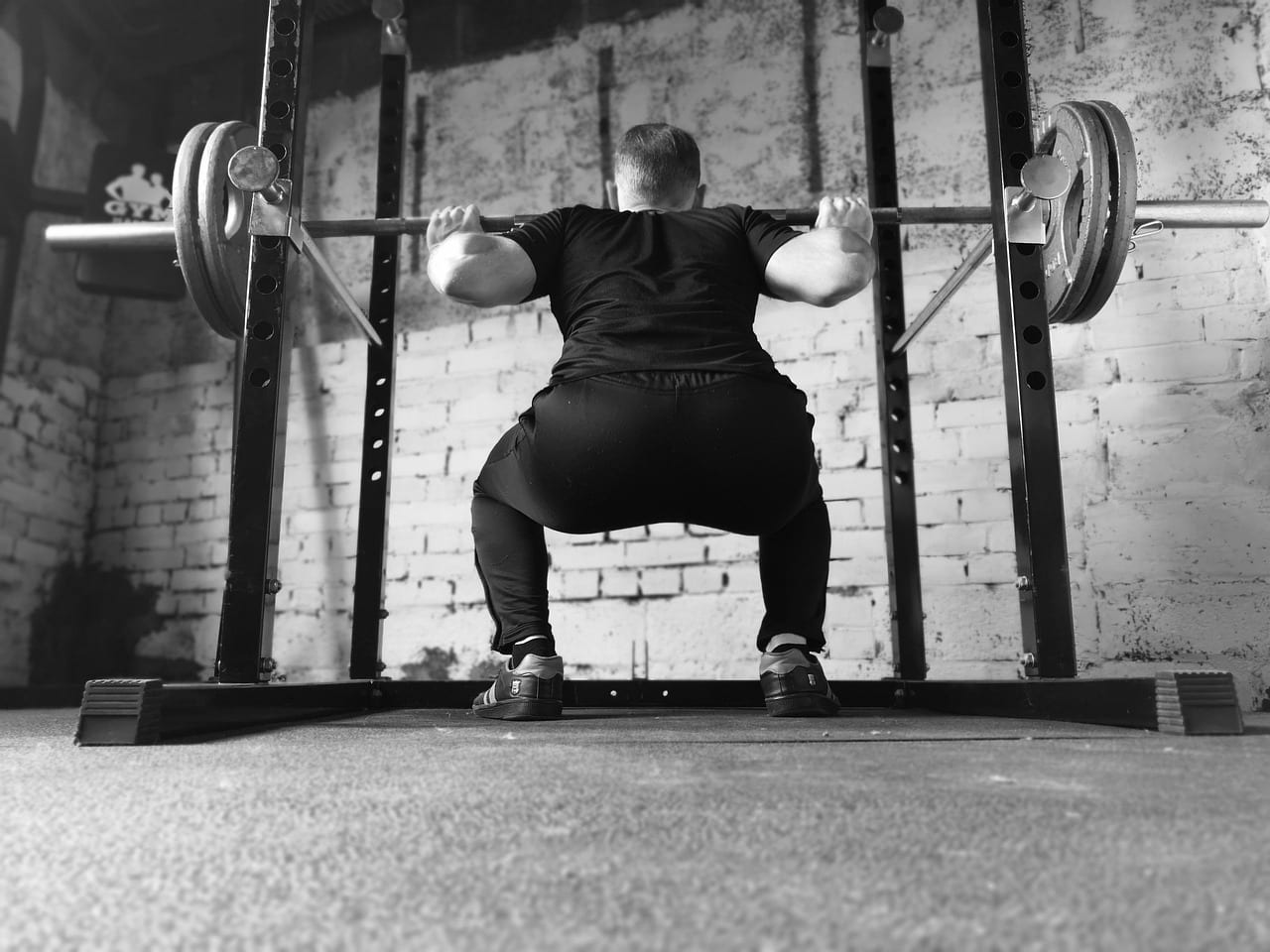
A standard conjugate schedule requires 72 hours of recovery between high-intensity demands on the same muscle groups. Splitting your training into two upper and two lower sessions ensures your central nervous system recovers before you attack another maximal effort.
Clinical recovery guidelines from the American College of Sports Medicine confirm that neuromuscular recovery from near-maximal efforts takes 48 to 72 hours. Spacing your heaviest lower body session on Monday and dynamic work on Friday respects this physiological timeline.
Here is the standard weekly template used by competitive powerlifters and strength athletes worldwide:
- Monday — Max Effort Lower: Heavy squat or deadlift variation working up to a 1-rep max, followed by hamstring, lower back, and abdominal accessory work.
- Wednesday — Max Effort Upper: Heavy bench press variation working up to a 1-rep to 3-rep max, followed by triceps, upper back, and shoulder volume.
- Friday — Dynamic Effort Lower: Submaximal speed box squats (10–12 sets of 2) paired with speed deadlifts (6–10 singles), followed by posterior chain work.
- Sunday — Dynamic Effort Upper: Submaximal speed bench press (9 sets of 3) with varied grips, followed by high-volume triceps and upper back accessories.
To succeed with this template, you need an established technical foundation on the primary barbell lifts; novices still making linear gains will see faster progress on simpler models like reverse pyramid training. Lifting with high intensity requires disciplined mechanics to prevent premature injury.
Selecting and Rotating Your Max Effort Lifts
You should rotate your primary max effort lift every seven days to avoid neuromuscular burnout while continuing to lift at 100% intensity. Intermediate lifters can occasionally hold a variation for two weeks, but advanced athletes must change variations weekly.
When selecting a variation, you are not inventing arbitrary exercises. You are modifying the competition lift to challenge different joint angles, change leverage, or overload sticking points using specialty bars, pauses, and deficits according to guidelines outlined in the Journal of Strength and Conditioning Research.
For lower body max effort days, select variations that heavily recruit the posterior chain and midsection:
- Safety Squat Bar Box Squat: Shifts the center of mass forward, forcing your upper back and abdominal wall to work significantly harder.
- Deficit Deadlift (1–2 inches): Increases the total range of motion, forcing greater quad drive and leg push off the floor.
- Low-Box Squat: Forces the hips below parallel, eliminating stretch reflex and challenging starting strength out of the hole.
- Rack Pull Below the Knee: Overloads grip, upper back musculature, and the final lockout phase of the conventional pull.
For upper body max effort days, target lockout strength and horizontal pressing mechanics:
- Floor Press: Removes leg drive completely, putting intense mechanical tension directly on the triceps, pecs, and front deltoids.
- Board Press (2-Board or 3-Board): Overloads your lockout strength with supramaximal loads while preserving shoulder joint health.
- Close-Grip Incline Bench: Emphasizes upper pectoral activation and triceps lockout strength without excessive shoulder strain.
- Swiss Bar / Football Bar Press: Allows a neutral wrist and shoulder position, sparing your joints during heavy pressing cycles.
When working up to your max effort single, perform three to five submaximal warm-up sets, then take single-rep jumps until you reach a technical maximum. While originally engineered for multi-ply powerlifters, modern raw lifters adjust the system simply by relying on fuller ranges of motion and reducing band tension percentages.
Programming Dynamic Effort Sets and Accommodating Resistance
Dynamic effort training is not conditioning; its sole purpose is to increase rate of force development by accelerating submaximal loads with violent intent. Moving a lighter weight as fast as humanly possible trains your central nervous system to recruit high-threshold motor units rapidly.
Research indexed on PubMed demonstrates that combining elastic resistance with free weights produces superior increases in peak rate of force development compared to free weights alone. Speed work relies on a three-week pendulum wave to cycle intensity systematically:
- Week 1: 50% barbell weight + 25% accommodating resistance (totaling 75% at lockout) for 12 sets of 2 reps on a 60-second timer.
- Week 2: 55% barbell weight + 25% accommodating resistance (totaling 80% at lockout) for 10 sets of 2 reps with identical rest intervals.
- Week 3: 60% barbell weight + 25% accommodating resistance (totaling 85% at lockout) for 8 sets of 2 reps driving peak bar velocity.
- Week 4 (Deload / Reset): Drop bar weight back to 50% or switch exercise variations entirely to initiate a new wave.
Crucially, the dynamic squat must be performed onto a rigid box. As demonstrated in peer-reviewed biomechanical analysis on Frontiers in Physiology, box squats break the eccentric-concentric chain, forcing you to develop pure starting strength without relying on elastic kinetic recoil.
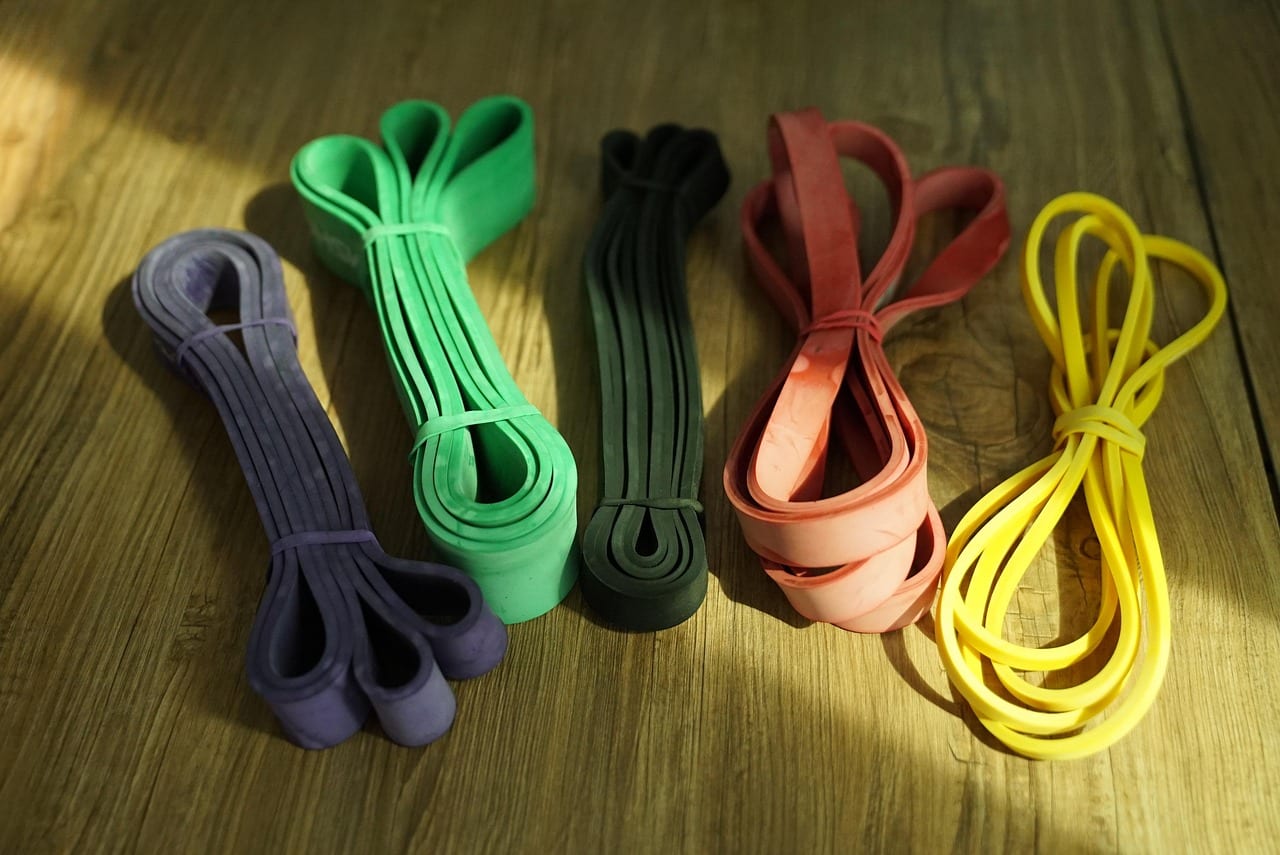
Adding accommodating resistance—such as resistance bands or heavy logging chains—counteracts natural barbell deceleration. A standard barbell becomes easier as you near lockout due to mechanical leverage, but bands stretch and load exponentially, forcing you to accelerate through the entire range.
Targeting Weak Points with the Repeated Effort Method
Your main lifts reveal your technical weaknesses, but the repeated effort method fixes them through targeted muscular hypertrophy. While max and dynamic effort lifts take the spotlight, accessory work accounts for 70% to 80% of your total training volume.
In the conjugate system, accessories are not arbitrary pump exercises. You identify the physical bottleneck that caused a missed max effort attempt—such as weak triceps during bench lockout or collapsing upper back in the squat—and hammer that muscle group with high volume.
Peer-reviewed studies on ResearchGate confirm that multi-joint isolation work directly strengthens neuromuscular weak links. Structure your accessory selection around your primary mechanical bottlenecks:
- Posterior Chain (Hamstrings & Glutes): Glute-ham raises, reverse hyperextensions, and Romanian deadlifts performed for 3 to 4 sets of 10 to 15 reps.
- Upper Back and Lat Lats: Chest-supported dumbbell rows, seal rows, and lat pulldowns executed for 4 sets of 12 to 20 reps to build a rigid shelf for squatting.
- Triceps & Lockout Capacity: Rolling dumbbell extensions, Tate presses, and close-grip pushdowns for 4 to 5 sets of 12 to 25 reps to bulletproof your elbows.
Managing these individual volume targets and fatigue metrics across multiple lifts can be simplified using AI for strength training, such as adaptive tracking in Fitnix to calibrate weekly recovery.
Accessory volume also strengthens connective tissue and tendon integrity, which helps ward off overuse injuries. Integrating structured hypertrophy principles with training for muscular endurance ensures your muscles can handle the weekly onslaught of heavy singles.
Field sport athletes frequently modify conjugate accessory volume to emphasize unilateral leg work and rotational power rather than maximal absolute bulk.

Can raw powerlifters successfully use the conjugate training system?
How often should I test my true competition lifts?
Do I need specialty barbells and chains to run conjugate?
What should I do if my bar speed drops on dynamic effort day?
Sources & References
- National Strength and Conditioning Association — Research and standards on concurrent strength periodization and neuromuscular adaptations.
- Vladimir Zatsiorsky Overview — Historical foundational research on the Law of Accommodation and athletic strength methods.
- Westside Barbell — Official repository of Louie Simmons' concurrent powerlifting methodology and training archives.
- ScienceDirect — Peer-reviewed studies on Henneman's size principle, motor unit recruitment, and maximal force production.
- American College of Sports Medicine — Evidence-based recommendations for resistance training frequency and neuromuscular recovery periods.
- Journal of Strength and Conditioning Research — Biomechanical evaluations of exercise variations and partial-range movement transfers.
- PubMed — Clinical research trials examining the impact of elastic resistance on peak rate of force development.
- Frontiers in Physiology — Biomechanical analysis comparing box squatting mechanics to free-weight back squats.
- ResearchGate — Published literature investigating multi-joint accessory training and targeted muscular hypertrophy.