
Blog
Full-Body Stretching Routine: A Daily Step-by-Step Guide
Master this 15-minute full-body stretching routine to loosen tight joints, ease back tension, and build lasting flexibility. Follow step-by-step form cues.

Full-Body Stretching Routine: A Daily Step-by-Step Guide
A targeted 15-minute sequence to release joint tension, lengthen tight muscle groups, and improve total-body range of motion.
This daily full body stretching routine takes just 15 minutes and requires only a flat floor and an exercise mat. Completing this sequence relieves muscular stiffness from prolonged sitting, resets joint alignment, and builds functional flexibility without complex equipment. Evidence reviewed by Harvard Health Publishing confirms regular flexibility training protects joint health and reduces postural discomfort.
Execution Rules: Hold Times, Breathing, and Setup
Every stretch in this sequence relies on static stretching to safely lengthen muscle tissue and surrounding fascia. Hold each position at the threshold of mild tension, aiming for a 4 to 6 out of 10 on an exertion scale. Never press into sharp or stabbing joint discomfort.
According to the National Academy of Sports Medicine, sustained tension for at least 20 to 30 seconds stimulates the Golgi tendon organs. This sensory mechanism overrides muscle spindle contractions through autogenic inhibition, allowing targeted fibers to relax and elongate safely.
- Warm baseline state: Spend 3 minutes walking or perform this sequence after light activity rather than from a cold start.
- Diaphragmatic breathing: Inhale for a count of 4 through your nose, then exhale for a count of 6 through your mouth.
- Target volume: Perform 1 to 2 sets per exercise, completing both sides before advancing down the kinetic chain.
- No ballistic bounces: Keep your body motionless at the hold position to prevent microtrauma in muscle tendons.
| Movement | Target Muscle Group | Prescribed Hold | Primary Form Cue |
|---|---|---|---|
| Levator & Upper Trap | Cervical extensors & neck | 20-30s per side | Depress opposite shoulder downward |
| Doorway Chest Stretch | Pectoralis major & minor | 30s hold | Elbows bent 90 degrees at shoulder height |
| Cross-Body Shoulder Stretch | Posterior deltoid & rotator cuff | 20-30s per side | Keep shoulder blade depressed and retracted |
| Cat-Cow to Child's Pose | Thoracic spine, lats & erectors | 30s dynamic flow | Synchronize pelvic tilt with breath cycles |
| Prone Sphinx to Cobra | Abdominal wall & anterior spine | 20-30s hold | Pull chest forward rather than compressing lower back |
| Supine Spinal Twist | Rotators, glute medius & lower back | 30s per side | Keep both shoulder blades flat against the floor |
| Half-Kneeling Hip Flexor | Psoas & rectus femoris | 30s per side | Tuck tailbone into a posterior pelvic tilt |
| Figure-4 Piriformis Stretch | Gluteus medius & deep hip rotators | 30s per side | Flex top ankle to protect knee joint alignment |
| Half-Kneeling Hamstring Hinge | Biceps femoris & semitendinosus | 30s per side | Hinge from hips with a flat, neutral spine |
| Wall-Supported Calf Stretch | Gastrocnemius & Achilles tendon | 30s per side | Drive back heel flat into the floor |

Upper-Body Stretches: Neck, Chest, and Shoulders
Desk work and smartphone use pull your cervical spine and shoulder girdle forward into chronic flexion. Clinical guidance from the Cleveland Clinic notes that releasing tightness across the anterior chest and lateral neck reduces tension headaches and restores scapular mechanics.
- Levator Scapulae and Upper Trap Stretch: Sit tall on a chair or mat with your spine erect. Anchor your right hand under your hip, then gently tilt your left ear toward your left shoulder. Turn your chin 45 degrees downward toward your armpit, applying feather-light fingertips pressure to the crown of your head for 25 seconds before switching sides.
- Doorway Pectoral Stretch: Stand in an open doorway. Place your right forearm flat against the door frame with your elbow bent at 90 degrees level with your shoulder. Step your right foot forward and rotate your torso slightly away until you feel a firm stretch across the chest and anterior shoulder. Hold for 30 seconds per arm.
- Cross-Body Shoulder Stretch: Bring your left arm across your chest at shoulder height. Hook your right forearm under your left elbow, pulling the arm gently closer to your sternum. Depress your left shoulder blade down away from your ear to isolate the posterior deltoid for 20 seconds.
If you are learning how to start a fitness routine, mastering these upper-body positions establishes the scapular mobility needed for fundamental overhead and pressing patterns.
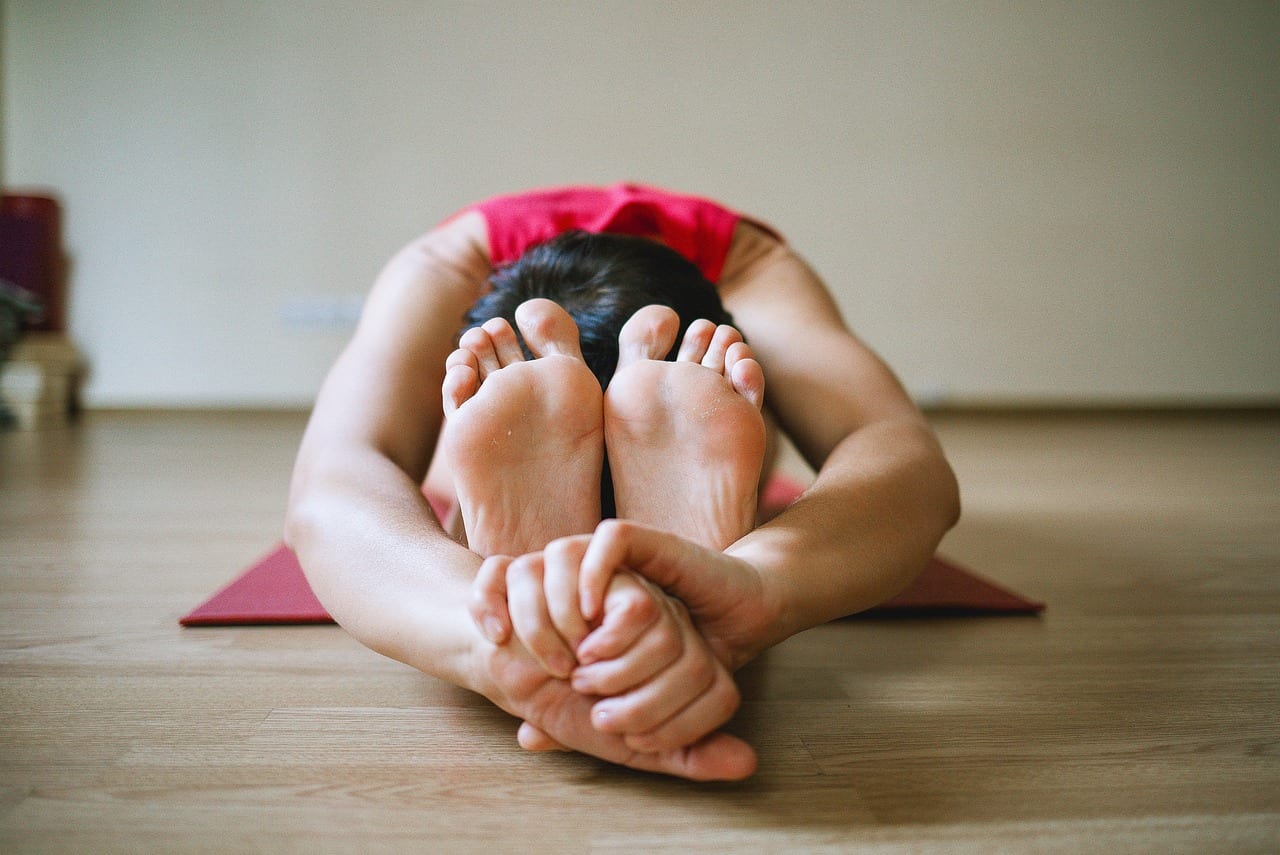
Trunk and Spine Stretches: Mid and Lower Back Decompression
Restoring rotational and extension capacity in the thoracic spine protects your lumbar vertebrae from bearing excess rotational load. Research from the Hospital for Special Surgery emphasizes that mid-back stiffness forces compensatory hypermobility in the lower back, elevating disk and facet joint stress.
- Cat-Cow into Child's Pose: Begin on all fours with wrists under shoulders and knees under hips. Inhale as you drop your belly and lift your chest for Cow pose, then exhale as you arch your spine toward the ceiling for Cat pose. Flow through 5 breath cycles, then push your hips back to your heels and crawl your fingertips forward into an extended child's pose for 30 seconds.
- Sphinx to Prone Cobra: Lie face down on your mat with legs extended straight. Place your forearms flat on the floor with elbows directly under your shoulders, pulling your chest forward through your arms to open the anterior abdominal wall. To advance, press into your palms with a slight elbow bend while keeping your glutes relaxed for 20 seconds.
- Supine Spinal Twist: Lie flat on your back, bend your right knee, and draw it toward your chest. Extend your right arm out perpendicular to your body, palm flat. Use your left hand to guide your right knee across your torso toward the floor on your left side. Keep both shoulder blades pinned to the floor and hold for 30 seconds.
Pairing spinal decompression with structural core activation from essential bodyweight exercises creates the muscular stability needed to maintain neutral posture during daily tasks.
Lower-Body Stretches: Hips, Hamstrings, Quads, and Calves
Sedentary hours leave the hip flexors and hamstrings in shortened positions that alter pelvic alignment. Data published by the American Council on Exercise highlights that tight anterior hip musculature induces an anterior pelvic tilt, inhibiting glute firing and straining the lumbar erectors.
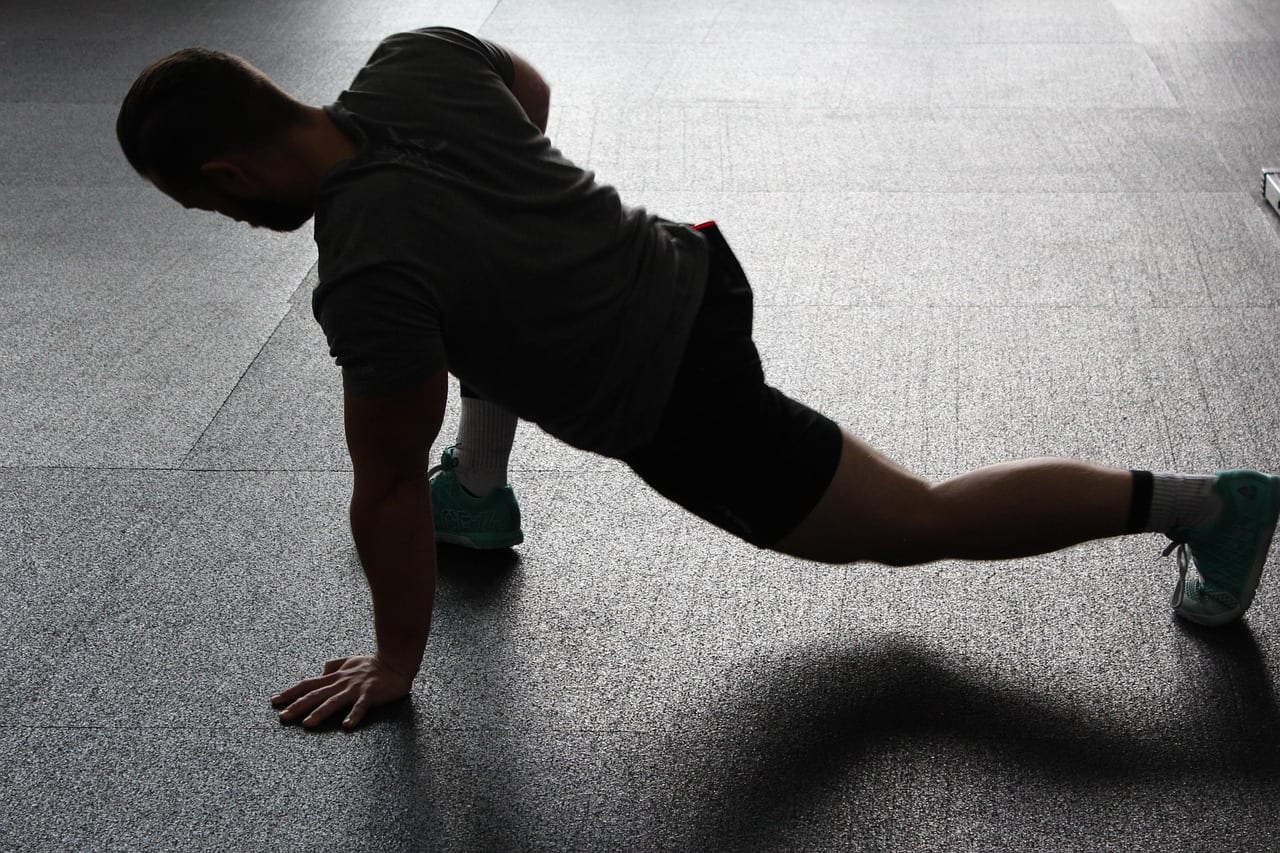
- Half-Kneeling Hip Flexor Stretch: Kneel on your left knee with your right foot flat on the floor ahead, creating two 90-degree knee angles. Squeeze your left glute and tuck your pelvis backward into a posterior pelvic tilt. Shift your hips forward 2 to 3 inches without arching your lower back. Hold for 30 seconds, then switch sides.
- Supine Figure-4 Glute Stretch: Lie on your back with knees bent and feet flat. Cross your right ankle over your left thigh just above the knee. Reach through to interlock your fingers behind your left hamstring, drawing the thigh toward your torso while keeping your head grounded. Hold for 30 seconds to stretch the piriformis and deep hip rotators.
- Half-Kneeling Hamstring Hinge: From a half-kneeling position, extend your front leg straight forward, resting on your heel with toes dorsiflexed upward. Place hands on your hips and hinge forward from the hip joint while maintaining an absolute flat back. Stop when you feel tension across the belly of the hamstrings and hold for 30 seconds.
- Wall-Supported Calf Stretch: Stand facing a wall with hands planted at shoulder height. Step your right foot backward roughly 2 feet, keeping the back leg locked straight with the heel pressed into the floor. Bend your front knee toward the wall until tension builds in the gastrocnemius. Hold for 30 seconds, then soften the back knee slightly to target the deeper soleus.
Routine Frequency, Timing, and Daily Scheduling
Flexibility gains require regular frequency over long intervals. Guidelines from the American College of Sports Medicine recommend performing targeted flexibility routines at least 2 to 3 days per week, with daily stretching providing the most rapid and permanent improvements in overall joint range of motion.
Timing dictates how your body responds to static work. Research cataloged in PubMed Central shows that long static holds temporarily dampen neural drive and maximum power output. Consequently, save this routine for your post-workout cool-down or evening relaxation rather than your pre-workout explosive prep.
- Post-workout window: Perform this sequence within 10 minutes of ending resistance training while muscle tissue temperature remains elevated.
- Evening decompression: Use this routine 1 hour before bed to downshift resting heart rate and reduce nocturnal muscle cramping.
- Midday work break: Split the sequence in half, executing upper-body and hip flexor stretches during lunch to mitigate desk fatigue.
To organize your training around these mobility sessions, integrate them directly into an adaptive custom workout plan that adjusts for weekly recovery demands.
Common Stretching Mistakes and Injury Prevention
Incorrect stretching form creates joint compression and microtears rather than tissue compliance. The clinical team at the Mayo Clinic warns that forcing cold, unyielding joints beyond their physiological barrier triggers inflammation in surrounding connective capsules.
- Spinal flexion during leg stretches: Rounding your thoracic and lumbar spine to touch your toes shifts tension from the hamstrings to the posterior spinal ligaments.
- Breath retention: Holding your breath triggers a Valsalva response, elevating blood pressure and signaling central nervous system distress that tightens muscles.
- Ignoring side-to-side asymmetries: Forcing an excessively tight left hip to match a flexible right hip invites unilateral compensation patterns.
- Ballistic end-range bouncing: Jerking movements activate muscle spindles that cause protective, reflexive shortening of the target muscle.
Stretching should feel like a deep, releasing tension rather than sharp joint impingement. If your face grimaces or your breathing stalls, back off the depth immediately.
If you want personalized guidance that automatically balances strength training with mobility and recovery days, consider using Fitnix to track and structure your progression.
How long does it take to see flexibility improvements from this routine?
Should I stretch before or after my workout?
Can I perform this full-body stretching routine every day?
What should I do if a stretch causes pinching or sharp joint pain?
Sources & References
- Harvard Health Publishing — Guidelines on the cardiovascular and mobility benefits of routine flexibility training.
- National Academy of Sports Medicine — Neuromuscular mechanics of autogenic inhibition and Golgi tendon organ activation.
- Cleveland Clinic — Clinical assessments of upper-body posture, forward head carriage, and pectoral tension.
- Hospital for Special Surgery — Biomechanical analysis of thoracic spine extension and lumbar compensation patterns.
- American Council on Exercise — Studies detailing hip flexor tightness, reciprocal inhibition, and pelvic tilt alignment.
- American College of Sports Medicine — Official exercise prescription standards for weekly flexibility volume and hold durations.
- PubMed Central — Research evaluating the acute neuromuscular impact of static stretching on power output.
- Mayo Clinic — Medical advisories on stretching safety, warm-up protocols, and injury avoidance.