
Blog
5 Day Workout Split for Hypertrophy: The Complete Routine
Build muscle with our complete 5 day workout split for hypertrophy. Explore daily exercise routines, weekly schedules, volume guidelines, and recovery tips.

5 Day Workout Split for Hypertrophy
Maximize weekly training volume and muscle protein synthesis with an evidence-based Push-Pull-Legs-Upper-Lower schedule.
Executing a structured 5 day workout split for hypertrophy allows you to maximize weekly training volume without burning out your central nervous system. Distributing your sets across five focused sessions provides the sweet spot between muscle growth stimulus and systemic recovery.
To run this routine successfully, you need access to a standard gym with barbells, dumbbells, and cable towers. Trainees with restricted schedules often turn to a 3-day workout plan or a 4-day upper lower split, but five days offers far greater flexibility for isolating lagging muscle groups.
Research published in Sports Medicine confirms that training muscle groups with a higher weekly frequency outperforms once-weekly splits by repeatedly stimulating muscle protein synthesis. This guide breaks down the exact layout, exercises, and volume targets you need.
Choosing the Best 5-Day Split Architecture for Hypertrophy
The Push-Pull-Legs-Upper-Lower (PPLUL) configuration is the most effective 5-day framework for muscle growth because it hits every major muscle group twice weekly. Traditional body-part splits dedicate an entire workout to one muscle group, which creates excessive localized soreness and leaves muscles idle for six full days.
A 2015 study in the Journal of Strength and Conditioning Research demonstrated that distributing training volume across multiple weekly sessions promoted superior hypertrophy compared to training a muscle group once weekly.
- Push-Pull-Legs-Upper-Lower (PPLUL): Provides ideal synergy by combining movement-pattern training early in the week with anatomical upper/lower targeting later in the week.
- Upper/Lower/PPL: Swaps the order to open with high-intensity compound loads on Upper and Lower days, finishing the week with high-volume PPL sessions.
- Traditional 5-Day Body-Part Split: Focuses on chest, back, shoulders, arms, and legs on separate days. It limits weekly frequency to 1x, which misses secondary growth windows.
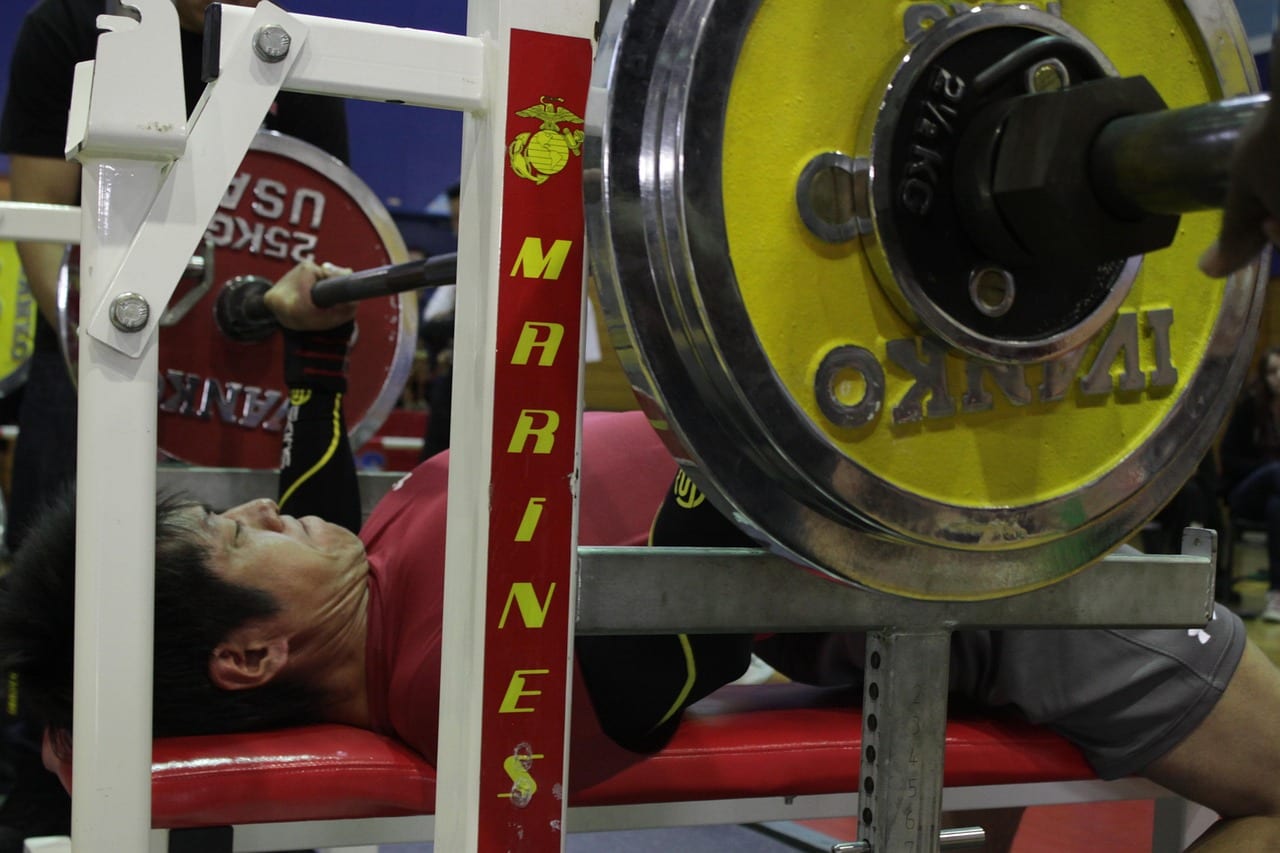
A 5-day cadence is ideal for intermediate lifters who have built baseline joint tolerance and know how to train within defined proximity to failure. True beginners often see exceptional progress on lower frequencies and should master movement mechanics before taking on five weekly sessions.
- Minimum lifting base: Trainees should possess at least 12 months of consistent resistance training before committing to five days.
- Recovery capacity: You need consistent sleep and a caloric intake at or slightly above maintenance to support five demanding sessions.
- Movement execution: Proper technique on foundational compound lifts is essential to prevent joint breakdown from repetitive weekly loading.
Weekly Scheduling and Strategic Rest Day Placement
Distributing your two weekly rest days asymmetrically prevents the cumulative central fatigue that degrades performance late in the training week. Lifting five consecutive days causes joint irritation and reduces your power output on Thursday and Friday.
The optimal weekly structure uses a 3-on, 1-off, 2-on, 1-off sequence. This layout places a dedicated recovery period after the grueling lower-body session on Day 3, setting you up fresh for the second half of the week.
| Day | Session Focus | Primary Muscles Worked | Recovery Target |
|---|---|---|---|
| Monday | Push (Strength Emphasis) | Chest, Anterior Delts, Triceps | Overnight rest, high carb intake |
| Tuesday | Pull (Strength Emphasis) | Lats, Upper Back, Rear Delts, Biceps | Active recovery, joint mobility |
| Wednesday | Legs (Quad Bias) | Quadriceps, Adductors, Calves | High post-workout nutrition |
| Thursday | Rest Day 1 | Full Body Recovery | Light walking, 8+ hours sleep |
| Friday | Upper Body (Hypertrophy) | Full Upper Torso, Arms | Hydration and central nervous reset |
| Saturday | Lower Body (Posterior Bias) | Hamstrings, Glutes, Calves, Core | Nutritional surplus for tissue repair |
| Sunday | Rest Day 2 | Full Body Recovery | Complete physical rest and meal prep |
If work commitments force you into a Monday-through-Friday schedule, you can train five days consecutively with weekends off. When choosing that setup, shift the highest-intensity sets away from Thursday to prevent output drops on your final upper-body day.
The Complete 5-Day Hypertrophy Workout Routine
This program balances heavy compound work in the 6–8 rep bracket with isolation work in the 10–15 rep range. Rest 2 to 3 minutes between multi-joint compound lifts, and limit rest to 60 to 90 seconds on machine and cable isolations.
Day 1: Push Focus
- Barbell Incline Bench Press: 3 sets × 6–8 reps (2–3 min rest, 2 RIR)
- Flat Dumbbell Press: 3 sets × 8–10 reps (2 min rest, 1–2 RIR)
- Standing Cable Lateral Raise: 4 sets × 12–15 reps (60 sec rest, 1 RIR)
- Dumbbell Overhead Shoulder Press: 3 sets × 8–10 reps (90 sec rest, 2 RIR)
- Rope Triceps Pushdown: 3 sets × 10–12 reps (60 sec rest, 1 RIR)
Day 2: Pull Focus
- Chest-Supported T-Bar Row: 3 sets × 6–8 reps (2–3 min rest, 2 RIR)
- Neutral Grip Lat Pulldown: 3 sets × 8–10 reps (90 sec rest, 1–2 RIR)
- Single-Arm Cable Row: 3 sets × 10–12 reps (60 sec rest per arm, 1 RIR)
- Face Pulls: 3 sets × 12–15 reps (60 sec rest, 1 RIR)
- Incline Dumbbell Biceps Curl: 3 sets × 10–12 reps (60 sec rest, 1 RIR)
Day 3: Legs (Quad Bias)
- Barbell Back Squat or Hack Squat: 3 sets × 6–8 reps (3 min rest, 2 RIR)
- Leg Press (Neutral Foot Placement): 3 sets × 10–12 reps (2 min rest, 1–2 RIR)
- Seated Leg Extension: 3 sets × 12–15 reps (60 sec rest, 1 RIR)
- Romanian Deadlift (Dumbbell): 3 sets × 8–10 reps (2 min rest, 2 RIR)
- Standing Calf Raise: 4 sets × 12–15 reps (60 sec rest, full 2-second stretch at bottom)
Day 4: Upper Body (Hypertrophy)
- Slight Incline Dumbbell Press: 3 sets × 8–10 reps (2 min rest, 1–2 RIR)
- Wide-Grip Seated Cable Row: 3 sets × 10–12 reps (90 sec rest, 1 RIR)
- Dumbbell Lateral Raise: 4 sets × 12–15 reps (60 sec rest, 1 RIR)
- Pec Deck Machine Fly: 3 sets × 12–15 reps (60 sec rest, 1 RIR)
- Overhead Cable Triceps Extension: 3 sets × 10–12 reps superset with Incline Hammer Curls: 3 sets × 10–12 reps
Day 5: Lower Body (Posterior Bias)
- Barbell Romanian Deadlift: 3 sets × 6–8 reps (2–3 min rest, 2 RIR)
- Lying or Seated Leg Curl: 4 sets × 10–12 reps (90 sec rest, 1 RIR)
- Bulgarian Split Squat: 3 sets × 8–10 reps per leg (90 sec rest, 1–2 RIR)
- Seated Calf Raise: 4 sets × 12–15 reps (60 sec rest, controlled tempo)
- Hanging Leg Raise: 3 sets × 12–15 reps (60 sec rest, deliberate pelvic tuck)
Volume Landmarks, Intensity, and Progressive Overload
Hypertrophy requires accumulating between 10 and 20 direct working sets per muscle group each week. While meta-analyses general suggest 10 to 20 weekly sets as a practical guideline, this specific 2019 trial in Medicine & Science in Sports & Exercise evaluated volume tiers up to 30–45 weekly sets, where the highest volume group showed the greatest increases in muscle size.
To trigger muscle hypertrophy, working sets must be performed with sufficient proximity to muscular failure. Training within 1 to 3 Reps in Reserve (RIR) provides optimal mechanical tension while keeping neurological fatigue manageable, as highlighted by Renaissance Periodization.
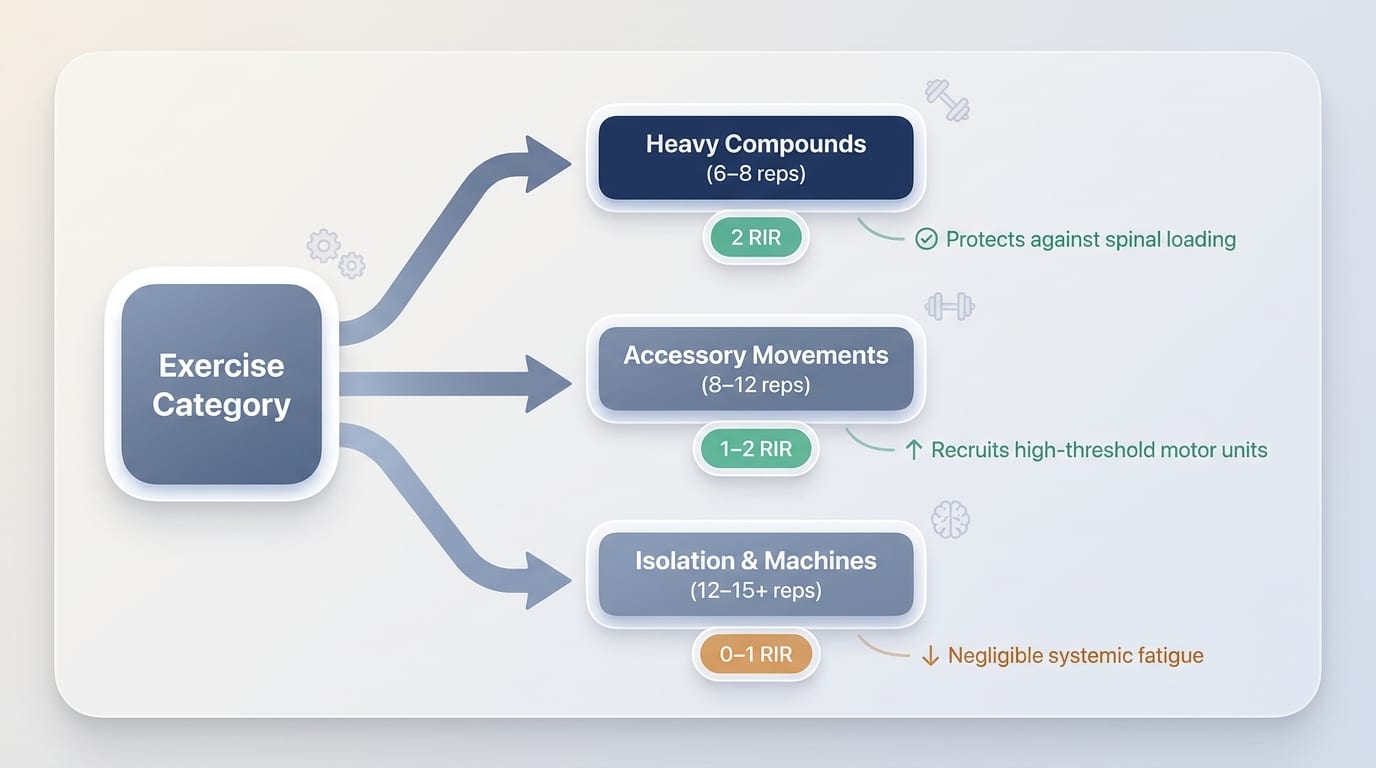
- Heavy Compounds (6–8 reps): Stop at 2 RIR. These lifts impose substantial spinal loading, making failure unnecessarily risky.
- Accessory Movements (8–12 reps): Train between 1 and 2 RIR to recruit high-threshold motor units without technical breakdown.
- Isolation & Machines (12–15+ reps): Push these sets to 0–1 RIR safely, as single-joint movements impose negligible systemic fatigue.
- Rep Range Diversity: Research synthesized by Stronger by Science shows equal growth across 6 to 30 reps when sets end close to failure.
Track your progress with the double progression method. Pick a target rep window, such as 8 to 12 reps with 80 pounds on a dumbbell press. Keep that weight until you can perform 12 clean reps across all three sets, then increase the load by five pounds and restart at 8 reps.
Lifters looking to remove guesswork can use tools like AI for hypertrophy to dynamically calibrate weekly volume and load jumps based on daily recovery markers.
Fatigue Management and Deload Protocols
Training five days weekly creates cumulative neurological and joint strain that simple sleep cannot fully clear over time. Systemic central nervous system fatigue impairs your brain's capacity to recruit high-threshold motor units, gradually stalling muscle growth.

A study in Frontiers in Physiology notes that persistent high-volume resistance training without planned recovery compromises muscle contractile efficiency. Watch for key signs of systemic overreaching:
- Grip weakness: Dumbbells and bars feel noticeably heavier in your hands during warm-ups.
- Joint aches: Persistent soreness in elbows, knees, or the lumbar spine that outlasts muscle soreness.
- Stagnating numbers: Inability to match previous rep counts on compound lifts for two consecutive workouts.
- Sleep disruptions: Waking up repeatedly throughout the night or feeling unrefreshed despite eight hours in bed.
Schedule a planned deload week every 6 to 8 weeks to flush fatigue. Cut your total working sets in half while keeping the weight on the bar the same, stopping every set roughly 3 to 4 reps short of failure. Additional reviews in Sports Medicine - Open emphasize deloading to resensitize muscle tissue to training volume.
Nutrition and sleep underpin your recovery: consume 1.6 to 2.2 grams of protein per kilogram of body weight daily and secure 7 to 9 hours of quality sleep. When managing a demanding routine, adaptive platforms like Fitnix automatically balance your session volume and deload triggers so you continue progressing without burnout.
Can beginners follow a 5-day hypertrophy split?
Is PPLUL better than a traditional bro split for muscle growth?
How long should each session take on a 5-day split?
What should I do if I miss a workout on a 5-day split?
Sources & References
- Sports Medicine Frequency Meta-Analysis — Systematic review confirming superior hypertrophy outcomes with higher weekly muscle training frequencies.
- Medicine & Science in Sports & Exercise Volume Study — Clinical dose-response trial tracking hypertrophy adaptations across various weekly set volumes.
- Journal of Strength and Conditioning Research — Research comparing split frequency and total volume distribution for athletic development.
- Frontiers in Physiology — Scientific publications investigating central nervous system fatigue and resistance training recovery dynamics.
- Stronger by Science Hypertrophy Guide — Evidence-based breakdown of effective hypertrophy rep ranges and proximity to muscular failure.
- Renaissance Periodization Training Hub — Practical volume landmarks and Reps in Reserve guidelines for physique athletes.
- Sports Medicine - Open — Peer-reviewed findings on fatigue dissipation and structured deload protocols.
- Wikipedia Muscle Hypertrophy Overview — Core physiological background on myofibrillar protein synthesis and mechanical tension.